Tales From the Workhouse 3 - The Fortune Family
Introduction
Whilst undergoing research for the article ‘Wigan Workhouse and the Poor Law Union’ I picked three names at random of inmates' that were resident in the workhouses at the time of the census taken on 3 April 1881. I was curious as to why they found themselves in the institution in the first place and what became of their lives and that of their families. The first two accounts were of Sarah Hartley and Elizabeth Thompson. The third article in the ‘Tales from the Workhouse’ series is the story of the Fortune family.
The Workhouse
The story begins on 2 October 1865 at St. John’s church in Clerkenwell, London. There 19-year-old George Fortune married 17-year-old Birmingham born Susannah Lucy Duffield. Their first known child, George William, was born on 1 June 1867.
Records show that two years later, on 10 April 1869 George, Susannah and their two-year-old son were admitted as inmates into St. Luke’s Workhouse in City Rd, Holborn. Because there was no modern social safety net, welfare benefits, or universal healthcare at that time, the decision to enter a workhouse was usually voluntary, but it was always a final act of desperation born out of absolute necessity.
Following the Poor Law Amendment Act of 1834, the government abolished ‘outdoor relief’ (financial aid or food given to people in their homes) and replaced it with the ‘workhouse test’. This meant that if an individual or family needed government welfare, they had to move inside the workhouse, where conditions were intentionally made harsher than the lowest paid outside labour, to deter people from relying on public funds.
At the time of entering the workhouse Susannah was pregnant with her second child. Fortunately, it was to be a relatively short spell in the dreaded institution, as records show that she gave birth to their second son, John James six months later, on 30 September 1869 in her home city of Birmingham.
The census taken on 2 April 1871 finds the family living at 11 Farndon Street in Wrexham, North Wales, and George’s occupation is shown as compositor. Sometime after June 1872 the Fortunes relocated to Wigan where their third son Charles Frederick was born on 15 October 1874.
Their fourth child, daughter Jessie was born on 23 December 1876 at 14 Prescott St, Wigan. On 10 October 1877 she was baptised at home in a private ceremony by Thomas James, the Curate of St. James’ Church in Poolstock. A private baptism at home usually indicated that the child was extremely sick and not expected to live, but in this case, Jessie survived into adulthood, married and had a child of her own.
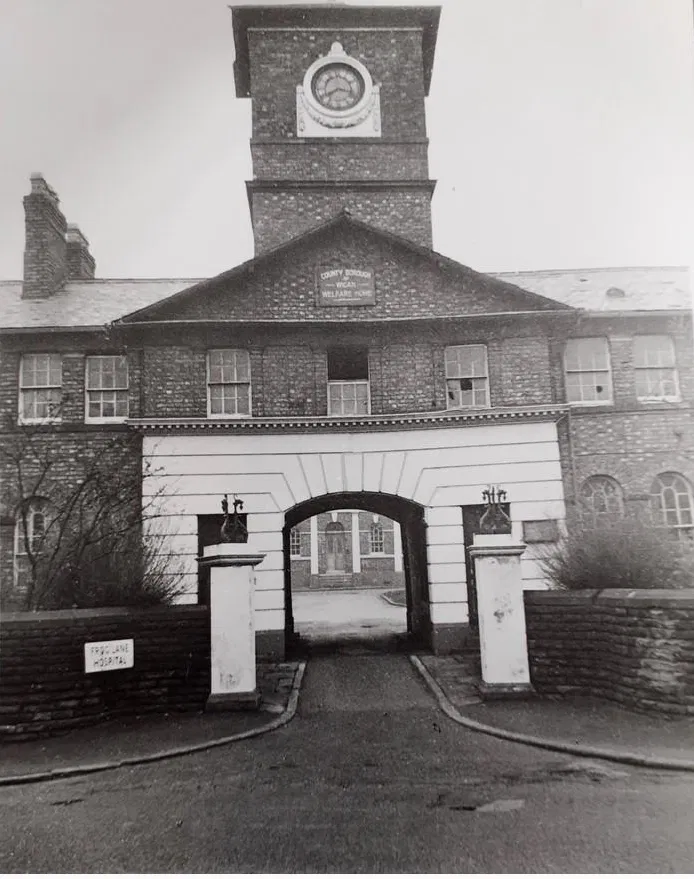
On 6 January 1880 tragedy struck the family when Susannah died at home at 105 Scholes, aged 32. She was buried in a public grave at Wigan Cemetery in Lower Ince, Plot F, Grave 186 CE. With four young children to care for and no immediate family in Wigan to help in any way George had no option but to leave his home and employment. For the second time in his life, he had no alternative but to seek assistance from the Poor Law Board of Guardians and find refuge in Wigan Union Workhouse in Frog Lane.
Upon entering the doors of the workhouse George and his children were immediately segregated and placed into distinct legal classifications based on age, health, and gender. Clothing and personal possessions were taken from them and stored, to be returned on their discharge. After bathing, they were issued with drab ill-fitting uniforms adorned with the Wigan Union mark. (Charles Dickens the renowned 19th-century author described workhouse attire as a metaphorical ‘badge’ of poverty, instantly recognisable to the local public).
George went to an able-bodied man’s ward, all three of his sons were completely separated into different under 14’s wards, and daughter Jessie went to a female dormitory. All contact between the siblings was banned. George was allowed limited access to his children; however, this contact was heavily supervised.
Furthermore, by entering the workhouse, George effectively surrendered legal custody of his children to the workhouse Board of Guardians. The Guardians had the legal power to apprentice the children out to employers in mills, mines and factories or send them away to district schools without the father’s permission or input.
For the previous 20 years Wigan Union Workhouse had been run by husband-and-wife team, John Lowe the Master, and Alice the Matron. In exchange for a roof over their heads, three meals a day, free health care and a basic education for children, inmates of the workhouse had to follow a strict daily routine set out in the 1834 Poor Law Act.
In the summer months inmates were woken at 6am by a rising bell. At 6.30 a roll call was held in the dining hall by John or Alice, this was followed by breakfast. Daily work commenced at 7am, all able-bodied men under 60 and children between the ages of 7 and 14 had to work at various activities to earn their keep, such as stone-breaking, which was used for road making, crushing bones to be used for fertiliser, crushing rocks of the mineral gypsum into powder to be used in plastering, sack-making, or oakum picking.
(Oakum is an old rope, sometimes tarred or knotted. The fibres from these ropes had to be teased out inch by inch by inch and a day's work would be to unravel on average two feet a day. The fibres would then be sold back to ship builders to be used as caulking between the wooden planks of the vessel, which would then be tarred to make it waterproof).
Female inmates did all the domestic work of cleaning, washing and cooking. However, the children’s day was broken up by schoolwork and religious education. The inmate's day ended at 6pm in the evening with an hour off for the mid-day meal. Supper was at 6.30 and they had to be in bed with candles out by 8pm.
In the winter months, the inmates’ day would start at 7am and they would be in bed by 7pm. Morning and evening prayers were said daily by the Master or Matron, and Grace was said before and after meals. Inmates had to attend Divine Service at a place of worship every Sunday, also on Good Friday and Christmas Day.
The following year the census of 3 April 1881 lists widower George and his three youngest children still in the workhouse along with over 500 other inmates. At the time of the census there were 290 male and 221 female residents in the workhouse. Of the under fourteens, there were 93 boys and 79 girls. Also, there were 17 infants under the age of two.
George’s eldest son George William, aged 13 is not listed as an inmate on the 1881 census. He was now on lodgings with Irish miner Thomas Connor and his family at 2 Mercer’s Yard off Warrington Road and was working as a pony driver in a pit.
At some point George felt his situation had improved sufficiently for him to discharge his family from the workhouse. The date and circumstances remain unknown as unfortunately the official admission and discharge registers for the Wigan Union Workhouse have not survived.
The next official record is the 1891 census which shows that George was employed in his chosen trade of letterpress printer (compositor) again. He was living in a two up two down terraced house at 75 Great George Street in Wallgate, along with his two youngest children Charles and Jessie. Also shown is George’s widowed mother Eliza, originally a native of East Brent in Somerset, she was visiting Wigan from her home in London.
Early the following year the four Fortune siblings were orphaned. Their father George died, aged just 45, in Great George Street, and was buried in a non-conformist grave, number E137 in Wigan Cemetery on 23 January 1892.
What then did the future hold in Wigan for the four Fortune siblings?
George William Fortune
George the eldest of the four siblings became an insurance agent and in 1888 married Jane Grimes in Leigh. They first lived at 75 Firs Lane but by the time of the 1891 census were living at 271 Twist Lane with their two children, Emily aged two and George William Jnr who was six months old. In February 1893 their third child Florence was born.
Following promotion and a new position in Burnley as an insurance superintendent in charge of a team of agents, he relocated his family there living at 26 Parkinson Street. On Wednesday 28 March 1894 George was involved in a fatal road traffic accident. An article in the Wigan Observer & Advertiser dated 4 April 1894 explains the circumstances. George had left his home at 9am to walk to his office in Bank Chambers in Burnley. Later he set off to cycle to Accrington to visit a new agent, approximately six miles away.
In Abbey Street in Accrington, he was cycling at the side of a tram car going in the same direction. The tram slowed down to turn left into Blackburn Road then stopped to let a couple of horses pass preventing George from continuing straight on. He swerved round the back of the tram to the right but was struck by a heavy steam driven lorry travelling in the opposite direction.
George was flung from his bike by the impact and knocked semi-conscious, passers-by went to his assistance and helped him into the nearby Crown Hotel where medical help was called. He was attended by a Dr. Lindsay who found that he was conscious and had no visible external injuries. However, his condition deteriorated overnight, and he died at the hotel the next day of severe internal injury and haemorrhaging.
At the inquest, his wife Jane told the coroner that although he could ride, he did not own a bike and supposed he had borrowed one from one of his men. The coroner stated that George was a stranger to the town and did not know the locality or he would not have come down the street at such a rate knowing the tram would cut him off at the corner of Blackburn Road. The jury returned a verdict of ‘Accidental Death’.
George was buried in Wigan Cemetery on 2 April 1894 in grave C26 non-Con. Four weeks later his fifteen-month-old daughter Florence died at Silverdale Terrace in Bryn, she was buried alongside her father on 5 May 1894.
Jane his widow married William Gorner, a widowed miner in 1897. After first settling at 3 Hope Cottages in Wigan Road Bryn, they moved to 318 The Avenue in Leigh. Census records show that they ran a restaurant in town.
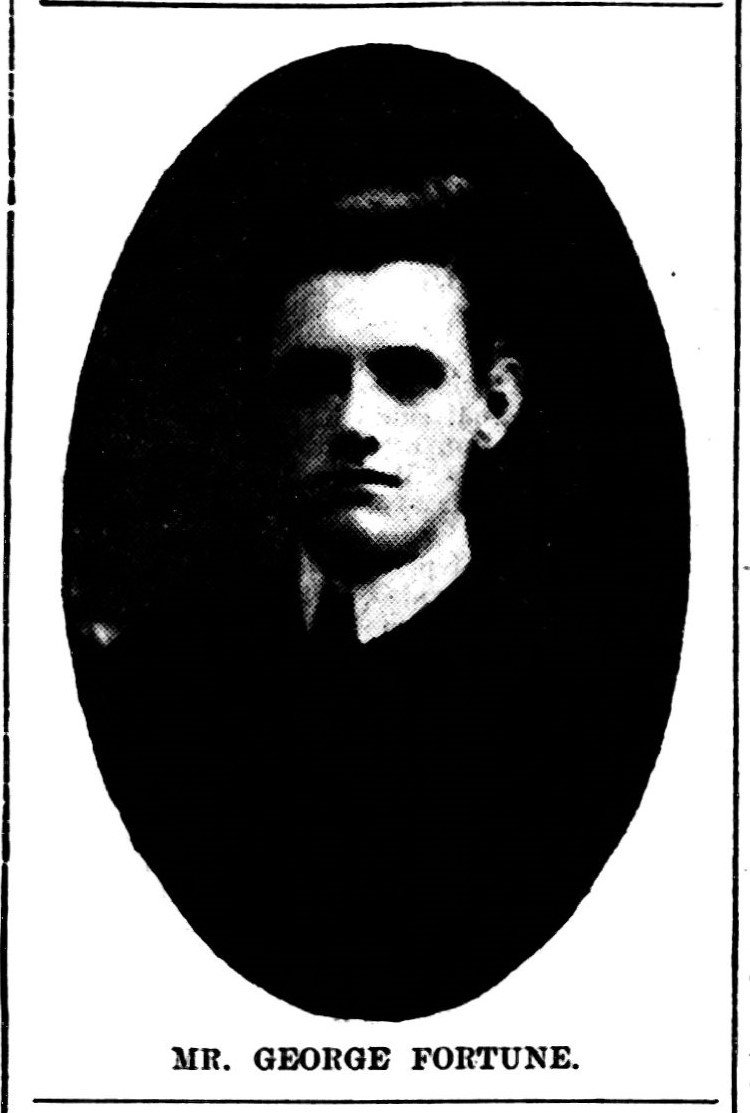
In 1910 tragedy struck the family again when George William Jnr died in tragic circumstances, aged just 19. George had a promising future ahead of him, after education at Ashton Grammar School he moved to Manchester Grammar School then onto Owens College in Oxford Road, Manchester where he was studying mathematics.
That year George was spending three weeks of his summer holidays working at Drummers Field Farm in Downall Green Road, Bryn. In the late afternoon of Wednesday 13th of July, he set off with three friends, his cousin 17-year-old Harold Fortune, Harry Hill aged 16, and 17-year-old Albert Walkden who lived next to the farm, to explore some old mine workings near the farm, accessible by holes in a field caused by subsidence.
After removing several spades full of earth Albert Walkden was the first to crawl into the cavity. George, who was behind him, realised he had stopped breathing and become immobile, he reached in to pull his friend clear, but he was also incapacitated. (The two teenagers had been overcome with black damp, a lethal mixture of odourless and colourless oxygen deprived gases that quickly suffocates).
Harold blew a whistle and shouted for help. Albert’s father who lived nearby rushed to help. He tried to reach the boys but was also overcome and had to be pulled out before he too collapsed. James Gibbons, a collier, who was working in the nearby Catholic churchyard of Our Lady Immaculate on Downall Green Road heard screams coming from the vicinity of the farm, 300 hundred yards away. He raced over to help and with a rope tied round his waist and a wet handkerchief wrapped round his mouth and nose he descended into the cavity to rescue the two youths. Despite feeling feint and breathless he then performed artificial respiration on them both. Medical assistance arrived in the form of Dr Winstanley who injected the boys with stimulants, but they were beyond help. At the inquest, the jury returned a verdict of death by misadventure through asphyxiation.
The tragedy had a profound effect on the residents of Bryn, crowds lined the streets, shops were closed and blinds drawn. The two friends were buried on the same day. After a short service by members of Bryn Baptist Church Albert Walkden was buried in the graveyard of Holy Trinity Church in Downall Green Road.
The funeral service for George was held at the Independent Methodist Church in Bryn, where he was a member of the Young Men’s Class and the Christian Endeavour Society. George was then interred with his father and sister in Wigan Cemetery on 16 July 1910. Later a memorial service was held at the Leigh Independent Methodist Chapel.
His mother Jane (Gorner) died in Hope Hospital in Eccles in 1933, she was buried on the 13th of January alongside her first husband George Fortune, her son George Jnr and daughter Florence in Wigan Cemetery.
John James Fortune
The 1891 census shows John James Fortune lodging with Edward Cowburn and his family at 36 Lorne St, Hardybutts, his occupation is shown as chemist’s bookkeeper and traveller.
Four months later, on 23 August 1892 he married Elizabeth Santus at the United Methodist Church in King Street, Wigan. Church records show that at the time of their marriage John was living at 110 Darlington Street East and Elizabeth at 17 Mount Pleasant Street in Oswaldtwistle, near Accrington.
Elizabeth, one of nine children, four boys and five girls, was born on 2 February 1871 at 73 Platt Lane in Scholes. Later her family moved to a larger property at 28 Whelley.
John and Elizabeth’s first child Harold was born 3 September 1893 at 3 Brookhouse Terrace, opposite the newly constructed Swedenborgian Jerusalem Church, close to the junction of Warrington Road and Darlington Street East.
John was a devoutly religious person and from an early age was active in the Temperance movement, being a member of Wigan Total Abstinence Society. In 1886 17-year-old John won 10 shillings for second prize in an examination arranged by Wigan & District Band of Hope. The subject was ‘Alcohol and its effect in the blood’. He became a prominent member of King Street Methodist church where he had been married, becoming its secretary in 1894, a position he was to hold for 42 years.
He was also Chairman of Wigan & District Junior Nonconformist Association and in time became a Methodist preacher on the Wigan circuit, on occasion assisting in wedding ceremonies. A member of the Methodist Free Church Band of Hope, he regularly entertained audiences with recitations at religious meetings. He became well known around town simply as J.J. Fortune.
In 1895 John’s name was mentioned in the local press when a list of those who had passed their ambulance examinations at Wigan Mining & Technical College was published on 10 May 1895, for which they received a medallion.
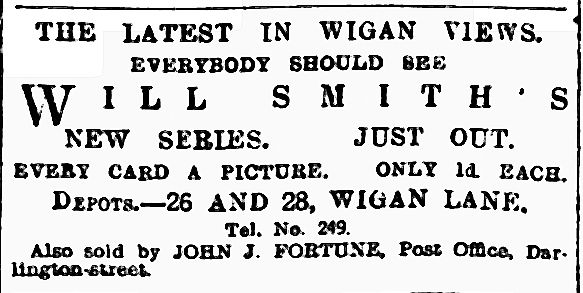
John and Elizabeth moved on from Brookhouse Terrace and took over the post office at 40 Darlington Street. As well as selling books and stationery, he also continued as a chemist’s bookkeeper and traveller. Elizabeth contributed to the finances by dealing in art needlework from the premises. Their daughter Mabel was born there on 29 September 1897. The 1901 census shows they had a live in domestic servant, 14-year-old Ellen Markland who came from Orrell.
Passive Resisters’ Movement
John became a prominent member of the Passive Resisters’ Movement, a massive campaign of non-violent civil disobedience launched in January 1903. It was organised to protest the Conservative government's controversial Education Act of 1902 (also known as the Balfour Act).
The Act abolished elected local school boards and transferred the administration of elementary education to local authorities. Crucially, it mandated that local tax rates (education rates) would be used to fund denominational religious instruction in voluntary schools, most of which were run by the Church of England and Roman Catholic Church.
The outraged Nonconformists (Methodists, Baptists, Congregationalists, and Quakers etc) vehemently objected to paying taxes that directly funded religious doctrines they did not believe in, viewing it as a direct violation of their religious freedom and conscience. They labelled it ‘Rome on the Rates’ and their motto was ‘No Say-No Pay’.
Led by the charismatic Baptist minister Rev. John Clifford, the dissenters formed the National Passive Resistance League. Their primary weapon was tax resistance, millions of citizens systematically refused to pay the portion of their local rates allocated for sectarian schools.
Summonses for non-payment were issued in recurring batches every six months when local/education rates were due to be paid. During the lifetime of the campaign there were over 70,000 prosecutions, and 170 men were jailed between the years 1903 to 1907.
When protesters refused to pay the court fines, the authorities issued distress warrants and sent bailiffs to seize their household property. Protesters would often keep a designated ‘Passive Resisters Chair’ or other household items such as clocks, books, or silver right by the front door for bailiffs to take.
The League coordinated highly publicised, non-violent rallies at public auctions held at inns or marketplaces, where the seized household goods were sold off to pay the tax debts. Sympathisers frequently attended these auctions to buy back the items and return them to the resistors, turning the sales into public protests. Prominent figures, including Rev. Clifford himself, faced dozens of magisterial hearings, asset seizures, and brief stints in prison.
The widespread public outrage generated by the ‘conscience wars’ deeply fractured the Conservative base and heavily contributed to the Liberal Party’s landslide electoral victory in 1906. The movement had a direct influence on the young Indian activist Mahatma Ghandi and helped shape his philosophies on civil resistance. It was also an inspiration for Women’s suffrage who later adopted identical tactics of tax refusal.
In Wigan large public rallies were held to organise the resistance. Local records note prominent passive resistance demonstrations taking place at the Wigan Public Hall in King Street on July 30, 1903, and again on October 26, 1905.
The town council was split into factions as was Wigan Education Committee; some members praised the act's administration in Lancashire, while local Liberal and Labour activists used the passive resistance movement to successfully rally working-class voters.
Stephen Walsh, though not a passive resister in the religious sense, was adopted as the Labour Candidate for the Ince Division in August 1903, right around the exact date of the mass Public Hall demonstration. Along with local miners' agents he actively capitalised on the anti-establishment fervour of the Passive Resisters to build the political coalition that would eventually result in the historic 1906 Liberal/Labour landslide victory.
During the period of the movement John was constantly writing letters in the local press columns holding the council and individual councillors to account over Council expenditure. In November 1906 John, along with his brother-in-law James Fletcher seconded the successful nomination of Albert Edward Stoker, a friend from the King Street Methodist Church to the role of Burgess Auditor. The auditors were citizens who were elected by the town’s ratepayers to independently review local public expenditures, tax usage, and municipal balance sheets to ensure financial accountability.
In October 1903 he wrote a scathing letter to the Wigan Observer and District Advertiser condemning the conduct of the Magistrates and their Clerk. He had received a summons to appear, along with 47 others, before the bench at 10am on Monday the 5th of October. He then received correspondence informing him that the case had been adjourned to the morning of the 7th.
On that day he received word that the adjournment had been refused by the bench and the case was now in progress. He hurried to the court, but it was too late, the magistrates had disposed of all the cases, and he was told by the Court Clerk his case could not be heard again.
Every year John would refuse to pay the full rate of tax and each year he would receive a summons for the outstanding amount. Sometimes he did not appear in court but awaited the usual demand for payment and a visit from the bailiffs.
In November 1905 John attended court with 44 other passive resistors. The Chairman of the Bench, Dr. Berry stipulated that speeches would not be allowed only legal objections. Solicitor Mr. J. A. Berry was allowed three minute to speak on all their behalf.
On 21 December of the following year, he was summoned again with 32 other defendants but did not appear in Court. The case had been adjourned twice awaiting the judgement by the House of Lords.
On 29 October 1908 the Wigan Observer & District Advertiser published an article listing 27 passive resistors summoned to Wigan Borough Police Court in respect of non-payment of poor rates. Summoned to Court along with John were three Non-Conformist Ministers, five Justices of the Peace and several prominent local businessmen.
The Rev. G. D. Thompson was allowed to make a statement on behalf of all the defendants. These included James Laycock, a cabinet maker of the Royal Hotel Yard in Standishgate. James Starr, who owned a printing and publishing company in Dawber Street. William Robert Deakin, resident at Gidlow Lodge, was the founder of Deakins Jam and owner of the Eclipse Jam Works in Princess Street, Wallgate. Lot J. Thorley, a fishmonger of 168 Wallgate and Thomas Livingstone Lace who ran an Ironmongers shop at 25 Market Place and was a neighbour of John in Kenyon Road.
Rev. J. A. Alderson asked what the penalty would be if he refused to pay, as before he had served two days in prison, he was informed that it would now probably be seven days in custody. The Court ordered John to pay the four pounds five shillings that he owed in unpaid taxes.
On 26 November 1912 John appeared in court again with 13 other passive resistors in front of a bench of six magistrates. Rev Ambrose spoke on behalf of the defendants. He stressed that the passive resistors were no students of the Pankhurst Academy who employed tactics of civil disobedience, direct confrontation, and attacks on property. They were peaceful, sober-minded, law abiding and level-headed citizens. Their opposition to the iniquitous Education Act of 1902 arose because of their sacred principles.
The outbreak of war in 1914 shifted national and Conformist focus towards the war effort, making tax strikes seem unpatriotic. Although the 1918 Education Act increased the amount central government paid towards education to 60%, the 1902 Education Act was never repealed. By the end of the war the movement had collapsed, and many non-conformists reluctantly accepted the dual system of state and church schools as permanent. However, the Passive Resistance Movement remains a notable chapter in Wigan's history of working-class and religious political activism.
The Uncle Joe’s Mint Balls Connection
J.J. fortunes brother-in-law was William Santus, his wife’s younger brother. William was a market trader selling fruit and vegetables from stall number 125 in Wigan Market Hall. After his marriage in 1898 to dressmaker Ellen Seddon, they lived in a small, terraced house at 6 Acton Street, off upper Dicconson Street. It was Ellen who possessed the skills for making the sweets and mints that were eventually to become the famous Uncle Joe’s mint balls. She had been taught by friends from the Atty family who had connections to the confectionery trade.
Ellen started making the mint balls in her tiny kitchen in Acton Street and sold them on her husband's market stall. By 1908 William owned market stalls, not only in Wigan but also at Bolton and St. Helens. The sweets were immensely popular and with business thriving the tiny kitchen in Acton Street was unable to cope. Being a shrewd businessman William realised it was time to expand and so the ‘Swinley Confectionery Company’ was born.
William went into partnership with his brother-in-law John who owned a property at 62 Kenyon Road. And so, in the shadow of the huge Rylands Cotton Mill, a small domestic factory was built where this new company would produce their mint balls and treacle toffee and other sweets. William sold his market stalls in Bolton and St. Helens to concentrate on his new enterprise in Wigan. The toffee was transported the short distance from Kenyon Road to the Market Hall by means of a truck pulled by a small boy named Eric.
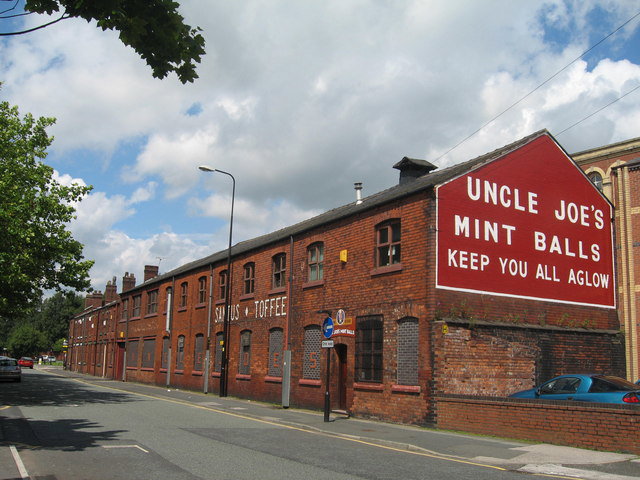
The high demand for the toffee made in Kenyon Road forced another move, one that was to last until the present day. Construction commenced on a new factory in Dorning Street, in the town centre. The new factory, which cost £2,400 took two years to complete.
When it finally opened production increased and so new workers were hired. William Santus was President of District Grand Lodge 152 of the Order of Independent Oddfellows and a staunch Methodist. He began an informal policy of only employing staff if they met two criteria. Firstly, they had to know someone who already worked at the factory – and they had to be Methodists. This assured that the working atmosphere was always friendly and happy.
The following year John, who had been an integral part of the firm decided to retire from the confectionery trade and concentrate on his property dealings, civic duties, and involvement with the Methodist church. The London Gazette records that on 28 April 1825 the partnership between William Santus of 52 Manchester Road, Southport, John James Fortune off 66 Kenyon Road. Wigan and Robert Seddon of 54 Hodges Street, Wigan was dissolved.

Following John’s departure, the name of the firm was changed from the Swinley Confectionery Company to William Santus & Company, a title it holds to this day. By clever marketing skills and shrewd business acumen William Santus ensured that the company continued its path to success. In 1932 the name ‘Uncle Joe’s Mint Balls’ was first introduced to the public and the following year the soon to become famous brand name was officially patented. The growing sweets empire was officially registered as a limited company in 1937.
William Santus died on 29 March 1953 age 79. He was buried in the churchyard of Christ Church, Douglas in Parbold on the slopes of Parbold Hill. Hs only daughter Nellie passed away three years later, on 27 July 1956, her father’s birthday. It is said she never got over his death. His wife Ellen died 16 December 1964 and was buried alongside her husband and daughter in Parbold.
Uncle Joe’s Mint Balls are still manufactured using the same traditional methods as when Ellen Santus originally made the sweets in her kitchen in 1898. The factory in Dorning Street, now called the ‘Toffee Works’ is run by John Winnard MBE and his brother Anthony. The famous slogan ‘They Keep You All Aglow’ is painted on the gable end of the factory and over the years has been seen by thousands of passengers on the nearby London to Glasgow railway line.
New Interests
Away from factory John took an interest in local politics, in 1919 he contested the Swinley Ward for the Liberal Party but lost by 519 votes to the sitting Conservative councillor James Walkden, who was elected the Mayor of Wigan later that year. In August 1924 John was appointed a Justice of the Peace for Wigan.
In 1928 John was elected to the Board of Guardians, representing Swinley Ward. For him it was a journey that had come full circle. The Board was the body that oversaw the workhouse in Frog Lane, where he had been an inmate 48 years before. His tenure was to be short lived however as the Board was on wind down and in its final phase of existence before it was abolished by the Local Government Act of 1929. The Board officially handed over its duties to the Public Assistance Committee in 1930.
That year John undertook two trips to New York; on 27 June 1928 he sailed from Southampton aboard the SS Homeric. On 31 October 1931 he departed Southampton on board the SS Laconia. The U.S Arriving Passenger and Crew Lists shows the purpose of his visit as an ecclesiastical conference. He is described as 5ft 7” tall, with brown eyes, brown hair, and a fair complexion.
At an early age John invested in property construction and development and built up a sizeable portfolio. By 1932 he had owned over 40 houses and cottages in the town. These included numbers 42 to 64 Wigan Road, Aspull, numbers 13 to 21 in Pearl Street, Gidlow, numbers 15 to 25 in Leeds Street, Wallgate, and numbers 53 to 57 in Upper Dicconson Street. Also, he owned individual properties at 3 Green Street, Aspull, 23 Hope Street in Wigan town centre, 62 Kenyon Road and ‘Wythburn’ at 363 Wigan Lane where he and Elizabeth retired to.
Elizabeth Fortune passed away on 23 January 1944 at the age of 73 and was buried at Christ Church, Douglas in Parbold. John James Fortune died in Wigan Infirmary on 2 April 1954, aged 84. At the time of his death, he was living with his son Harold at 177 Wigan Lane, just across the road from the hospital. He was buried alongside Elizabeth in Parbold, close to the grave of his brother-in-law and business partner William Santus.
Harold and Mabel
His children Harold and Mabel requested no flowers but gifts in lieu of the Methodist Overseas Missions, Methodist Homes for the Aged, National Children’s Homes, or the British and Foreign Bible Society.
Following the example set by their father and uncles, both Harold and Mabel became prominent members of King Street Methodist church. Mabel became a local preacher on the Wigan Methodist circuit like her father. Both became accomplished pianists and Mabel became a member of the church choir.
In 1905 Harold won a four-year scholarship to Wigan Grammar School. He went on to serve an apprenticeship with Mr. J. Pennington of the Crawford Pharmacy at 25 Standishgate, Wigan, and qualified as a chemist and druggist of the Pharmaceutical Society of Great Britain in 1914.
In 1919, following the end of the Great War he married Kate Cooke, whose family originated from Norfolk, at King Street Methodist church. They set up home in a bay windowed terraced house at 51 Throstlenest Avenue in the Gidlow area. Two years later the 1921 census reveals that Harold had followed in his father’s footsteps and was working for William Santus as a confectioner's traveller. Their daughter Joan was born in July 1924. Kate passed away on 27 March 1965 aged 73. Harold died at Silverdale, near Carnforth on the 31st of October 1975, aged 82.
In 1910 Mabel Fortune gained top marks and grade one honours in the practical examinations held by the Incorporated Society of Musicians. Four years later she won the Wigan County Borough University Scholarship and awarded a bursary. After graduating at Manchester University, she took her teaching diploma. The 1921 census finds her as a kindergarten mistress in Dewsbury, West Yorkshire.
Following several teaching appointments, in 1924 she was appointed Principal of the girls' school at Ning Po, in the province of Chekiang on the East China Sea. (Now the modern-day Ningbo, Zhejiang, province). In 1928 she married Dr. Edward Stedeford, a Methodist preacher's son from Worle in Somerset.
Edward had been a missionary doctor at Wenchow Hospital since 1914,a period of upheaval and dangerous uncertainty. The fledgling Republic of China suffered widespread devastation as warlords fought constant territorial wars, levied crushing taxes on peasants, allowed local administration and infrastructure to decay leading to severe poverty and famine. The couple had a son named Roland, born in 1931.
Edward died in 1971 in Birmingham aged 84. Mabel died in 1978 in Islington, London at the age of 81.
Charles Frederick Fortune
On the 1891 census 16-year-old Charles Frederick was living with his father, grandmother, and sister Jessie at 75 Great George Street in Wallgate. He was employed as a labourer in the warehouse of a local mill but later entered the grocery trade.
Charles married Jane Sherrington on 13 May 1896 at St. Catharines church in Scholes, his sister Jessie and Jane’s brother Ralph acted as witnesses. Jane’s father was a well-known furniture broker in the town. Their first child George William, (named after his elder brother who had died three years previously) was born the following year, followed by Charles Jnr who was born 18 December 1899 in Essex Street, Whelley.
The 1901 census finds Charles living at 298 Wigan Road Bryn, where he was a grocery shop manager. His third son Frank was born next door at number 296 on 17 June 1904. By 1908 Charles was running a grocery business at 409 Wigan Road, Bryn but was residing at 34 Darlington Street in Wigan, three doors away from his older brother J.J. Fortune.
In March 1918 during the last year of ‘The Great War’, his second son Charles Jnr joined the Air Force just as the Royal Flying Corps and the Royal Naval Air Service were combining to become the fledgling Royal Air Force. He graduated as a Second Lieutenant at Number 2 Officer Technical Training School at Hastings in Sussex. He was then posted as an Observer to RAF Eastchurch, a home defence airfield on the Isle of Sheppey in Kent.
In 1919 after the war, Charles Snr moved from Darlington Street to 68 Widdrington Road, off Wigan Lane. The 1921 census reveals that Charles was now the co-owner, along with Thomas Latham of the Fylde Jam Company operating from Percy Street in Preston.
This partnership was eventually dissolved on 25 August 1924 with Charles continuing the business on his own. His grocery business at 409 Wigan Road Bryn, known as C. Fortune & Sons, was now run by his three sons. At some point George and Frank made career changes leaving Charles Jnr to run the grocery business in Bryn. George became a clerk in the civil service. Frank, who settled in Wigan Road Standish became the proprietor of a petrol filling station in Warrington Road, Marus Bridge.
In 1930 Charles Frederick’s wife Jane died at the age of 54. Two years later he married for a second time to widow Lillie Gaskell, a 53-year-old health visitor who lived in Birch Street, Springfield. After their marriage they moved to Thornton-Cleveleys, where the UK Register taken in September 1939 shows Charles running a grocers shop at 29 Victoria Road East. They later returned to Wigan to live in Dorning Street, close to the Uncle Joe’s factory.
Charles Frederick Fortune died in Wigan Infirmary in early 1943, aged 68. He was buried in grave C448 non-Con in Wigan Cemetery on 16 January alongside his first wife Jane. His second wife Lillie died in Billinge Hospital in 1959 aged 81, and was buried in Wigan Cemetery, grave H51 CE.
Jessie Fortune
On the 1891 census 13-year-old Jessie was a domestic nurse living with her father, grandmother and brothers at 75 Great George Street. On 16 August 1899 she married James Fletcher, who ran a drapery business at 518 Ormskirk Road Pemberton, at the Methodist Free Church in King Street, Wigan. Their daughter Kathleen was born there in March 1901.
By 1911 James, with Jessie as assistant was also operating a drapery business at 91 Wallgate, on the corner of Caroline Street. Together they built a successful chain of drapers' shops. The Wigan Observer & District Advertiser dated 14 October 1916 ran an advert announcing the opening of a new shop five days later at 31 Market Place in the centre of town. By 1921 they had also opened branches in Ashton in Makerfield and Golborne.
James and Jessie went to live at 64 Kenyon Road, next door to her brother John. James died in 1930. Jessie died on 27 April 1936 at ‘The Manse’ in Tockholes, near Darwen. the home of her daughter and son- in-law, the Rev. Herbert Starkie. At the time of her death, she was living at ‘The Laurels’ at Greenhill in Wigan Lane.
In conclusion the story of the four Fortune siblings demonstrates that despite the stigma of living in Wigan Union workhouse at an early age, the hardships thus endured, and the loss of their parents. They and their offspring all made a success of their lives and careers, leaving a lasting mark on the town’s civic, business and religious community.
Graham Taylor 2026
Associated reading
‘Wigan Workhouse and the Poor Law Union’. https://www.wiganlocalhistory.org/articles/wigan-workhouse-and-the-poor-law-union
'Tales from the Workhouse 1 – The Story of Sarah Hartley'. https://www.wiganlocalhistory.org/articles/tales-from-the-workhouse-the-story-of-sarah-hartley
'Tales from the Workhouse 2 – The Bizarre Tale of the Infant Burial'. https://www.wiganlocalhistory.org/articles/tales-from-the-workhouse-the-bizarre-story-of-the-infant-funeral
Sources
AI Overview
Ancestry
Find My Past
General Registry Office BMD Index
Lancashire Births Marriages & Deaths
Lancashire Online Parish Clerk
Newspapers.com
Uncle Joe's official website
UK & Ireland Outward Passenger 1890-1906
Wigan Workhouse and the Poor Law Union
Wigan World