The Receptacle, Haigh
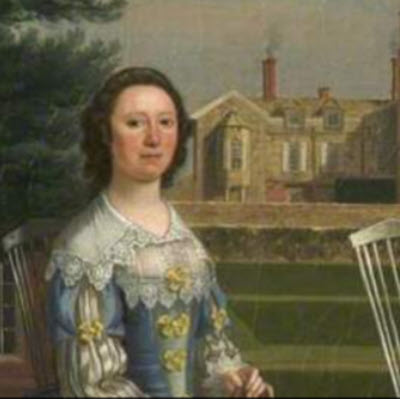
Dame Dorothy Bradshaigh's Remarkable Charity for the Poor
An eighteenth-century institution that provided a home, financial security and dignity for the poor of Haigh and the surrounding Wigan district.
Among the historic buildings associated with the Haigh estate, few tell a more compassionate story than the Receptacle, an almshouse established through the generosity of Dame Dorothy Bradshaigh during the eighteenth century. Conceived as a refuge for the elderly and impoverished, it provided accommodation and financial assistance for twenty people at a time when there was little organised provision for those unable to support themselves.
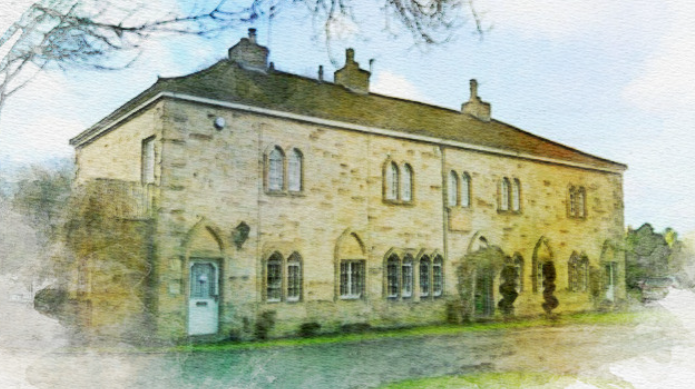
The Receptacle was more than a collection of charitable dwellings. It was an institution supported by a permanent endowment, governed by carefully drawn legal arrangements and closely connected with the Bradshaigh family, the Earls of Balcarres and the clergy of Winwick.
A detailed investigation by the Charity Commissioners in the early nineteenth century provides a fascinating account of its foundation, finances and administration. Their report also offers a rare glimpse into the lives of the people who depended upon the charity.
Dame Dorothy Bradshaigh and the Foundation of the Receptacle
The origins of the Receptacle can be traced to Dame Dorothy Bradshaigh, widow of Sir Roger Bradshaigh of Haigh Hall. The Bradshaighs had long been among the principal landowning families in the Wigan district, and their estate at Haigh was closely associated with the economic and social life of the surrounding townships.
Dame Dorothy determined to establish a permanent charitable institution for poor inhabitants of Haigh, Wigan, Blackrod and Aspull.
By an indenture dated 14 July 1775, enrolled in the High Court of Chancery, she conveyed the property to three trustees: Sir Richard Clayton, Baronet, Roger Palmer and Geoffry Hornby.
The Commissioners recorded that Dame Dorothy had already erected the building at her own expense. It consisted of ten separate dwellings, each containing a ground-floor room with an adjoining pantry and a chamber above.
A small garden was allotted to each dwelling, and the entire site, including its boundaries, measured approximately 160 feet by 116 feet.
The accommodation was intended for twenty poor people, either men or women, with married couples also able to occupy the premises.
The original deed made clear that the institution was intended to continue permanently as an almshouse, providing a home and maintenance for those selected to receive its benefits.
The charity was initially intended for inhabitants of Haigh, Wigan, Blackrod and Aspull. Only if suitable beneficiaries could not be found in those townships were the trustees permitted to select residents from elsewhere.
This geographical provision demonstrates that Dame Dorothy's intentions extended beyond the immediate Haigh estate to the wider district with which her family had longstanding connections.
The Bradshaigh Legacy and the £3,000 Endowment
Although Dame Dorothy had paid for the construction of the building, she recognised that its continued operation would require a secure income.
Her will, dated 28 July 1780, provided for a sum of £3,000, which had been charged upon the Haigh estate under the will of her late husband, Sir Roger Bradshaigh.
The intention was that this money, together with the interest due upon it, should be raised by the appropriate trustees and invested in government securities or mortgages upon land.
The income was to be used to maintain the Receptacle, repair the buildings, provide for its inhabitants and meet other charitable expenses.
A codicil dated 6 May 1784 gave further directions concerning the application of part of the proposed endowment.
However, the Commissioners' report reveals that the financial arrangements did not proceed exactly as Dame Dorothy had intended.
Under an indenture dated 3 March 1787, it was recorded that her proposed £3,000 charitable bequest had been rendered void by the statute of mortmain, legislation restricting certain transfers of property for charitable purposes.
This presented a considerable difficulty. Although the Receptacle had already been built, its intended financial provision was legally uncertain.
The matter was resolved through arrangements involving Alexander, Earl of Balcarres, and Elizabeth Palmer, who was entitled to benefit from Dame Dorothy's personal estate.
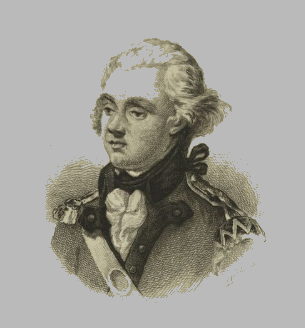
The Earl of Balcarres agreed that the building and its grounds should continue to be used as an almshouse. He also paid £2,000 from his own money to Roger Palmer and Geoffry Hornby, the acting executors of Dame Dorothy's will.
This sum was accepted in connection with the proposed charitable legacy, and arrangements were made to secure the future of the institution.
The intervention of the Earl of Balcarres was therefore of considerable importance. Without these arrangements, the Receptacle might have faced serious difficulties in securing the permanent income required to maintain its residents.
A Building designed for Charity
The Receptacle was constructed in 1772, three years before the formal deed establishing its charitable purpose.
A historical assessment of Haigh Woodland Park identifies Mr Gudgeon as the architect, Richard Melling, possibly of Brock Mill Forge, as the civil engineer and Michael Barker as the stonemason. The recorded construction cost was £608 18s., and the building was erected in memory of Sir Roger Bradshaigh, who had died in 1770.
The building was constructed of dressed stone with ashlar detailing and a hipped stone-slate roof. Its architectural character was unusually distinctive for an almshouse, incorporating pointed windows, rusticated corner stones and carefully arranged entrances.
The two-storey building had five bays on its principal elevation, with a corresponding arrangement to the rear. Although modest compared with Haigh Hall, the quality of its construction reflected the standing of its benefactor and the expectation that the institution would survive for generations.
The original accommodation was necessarily simple. Each household had a downstairs living room and pantry, a sleeping chamber above and access to a small garden.
For elderly people who might otherwise have faced considerable hardship, such accommodation represented a degree of security that was far from universal in eighteenth-century Lancashire.
The Charity's Income and Investments
By the time of the Charity Commissioners' investigation, the £2,000 endowment had been invested in government securities.
The Commissioners recorded that the money had purchased £4,555 8s. 3d. in three per cent interest, held in the names of the Honourable and Reverend George Bridgeman and the Reverend James John Hornby. These investments produced an annual dividend of £136 13s. 2d.
The annual income was intended to support the residents, pay the chaplain, provide medical assistance and maintain the building.
Before 1816, when property tax was still deducted, the charity's annual income amounted to £122 19s. 10d.
The Commissioners recorded that its regular expenditure had included £80 in allowances to the residents, £10 for a chaplain and £10 for an apothecary.
The balance was used for repairs and additional assistance, particularly during illness.
In the six years preceding the investigation, the average annual expenditure had been approximately £108, including £12 for medicines and medical attendance, £5 for repairs and £1 10s. for assistance during sickness.
These accounts demonstrate that the Receptacle was not simply a building provided without rent. It was a continuing charitable establishment, with a modest but regular financial provision for the people living there.
Twenty Residents and a Quarterly Allowance
One of the most revealing passages in the Commissioners' report describes the actual residents of the Receptacle.
At the time of the investigation, there were ten men and ten women, including three married couples.
Most had been selected from Haigh, although two or three came from Wigan and one from Aspull.
Each resident received an allowance of £1 every quarter, equivalent to £4 annually. This was a small sum, even by contemporary standards, but it was intended to supplement the considerable benefit of having a home.
The residents also benefited from the services of a chaplain and an apothecary, while additional assistance could be provided during periods of illness.
The Commissioners noted that the buildings were in good repair and that each tenement had a small garden.
For the occupants, the gardens would have offered both recreation and the possibility of growing vegetables or other produce, although the report does not specify how the plots were cultivated.
The Receptacle was therefore a small community, with its inhabitants sharing the same charitable foundation while retaining separate domestic accommodation.
It is particularly interesting that married couples were admitted. This meant that some elderly husbands and wives could remain together rather than face separation through other forms of poor relief.
The Rules and Selection of Residents
The charity was established under a carefully controlled system of nomination and supervision.
The original deed gave the trustees authority to appoint residents, regulate their conduct and remove anyone whose behaviour was considered unacceptable.
It also allowed them to suspend allowances or impose other sanctions for misconduct or disobedience.
This reflected the prevailing eighteenth-century belief that charitable assistance should be accompanied by expectations of orderly behaviour.
After Dame Dorothy's death, the power of nomination was intended to pass to the owner of the manor of Haigh.
By the time of the Commissioners' investigation, the Earl of Balcarres was exercising this responsibility.
The charity therefore remained closely associated with the Haigh estate, even though its original terms had permitted beneficiaries from several surrounding townships.
Later accounts indicate that preference was increasingly given to former workers from the Haigh coal mines.
By 1899, applicants were expected to be over fifty years of age and regular church attenders, with particular preference given to inhabitants of Haigh who had worked in the mines.
This later development reflected the changing social and industrial character of the district. As coal mining became increasingly important to the economy of Haigh, the Receptacle provided a potential refuge for men whose working lives had been spent in a physically demanding occupation.
William Wiswell of Billinge and the Administration
The Commissioners' report provides a particularly interesting account of the management of the charity's funds.
From 1810, the dividends were received by William Wiswell of Billinge, who was responsible for making payments and meeting the institution's expenses.
Wiswell had originally been employed by the Honourable and Reverend George Bridgeman, for whom he acted as steward.
He appears to have undertaken the management of the Receptacle at the request of the Reverend Geoffry Hornby, Rector of Winwick.
For many years Wiswell collected the income, paid the residents' allowances, settled the chaplain's salary, arranged medical payments and dealt with repairs.
In 1824, however, he ceased acting as steward to Bridgeman.He subsequently submitted his accounts to Bridgeman's solicitor, who informed him that the Reverend James John Hornby, then Rector of Winwick, was the sole trustee of the charity.
Wiswell approached Hornby and was asked to continue administering the funds in substantially the same manner.
The Commissioners nevertheless identified a weakness in the arrangements.
They observed that Wiswell's accounts had not been examined by Hornby or another responsible person since their submission to Bridgeman's solicitor.
The investigation was not an allegation that Wiswell had misappropriated money. Indeed, the Commissioners acknowledged that he had carried out his duties without charging for his time.
Their concern was that the charity's finances required proper supervision and that responsibility for administering the endowment should be clearly established.
A Surplus in the Charity's Accounts
The financial examination revealed that the Receptacle had accumulated funds beyond its immediate expenditure.
In 1816, the accounts showed a balance of £150 due to Wiswell, indicating that he had advanced money in the course of managing the charity.
This debt was gradually extinguished, by September 1818, however, the position had reversed, and Wiswell held a balance of £211 13s. 6d. belonging to the charity.
The Commissioners considered what should happen to the accumulated funds. They suggested that it might be reasonable to compensate Wiswell for his administrative work, for which he had not previously made a charge.
They also recommended that the Rector of Winwick should consider whether the remaining balance ought to be invested to increase the charity's capital or spent for the benefit of the existing residents.
The Commissioners concluded that the power to administer the funds rested with the Reverend James John Hornby and his successors as Rectors of Winwick.
They considered that the rector should direct and supervise the application of the income and examine the accounts.
The report consequently provides an important insight into the financial administration of an eighteenth-century charity during the early nineteenth century.
It also demonstrates the complexity that could arise when responsibility for buildings, investments, appointments and expenditure was divided between different trustees and estate interests.
The Earls of Balcarres and the Continuing Haigh Connection
The Receptacle's history cannot be separated from that of the Haigh estate.
The Bradshaigh family had established the institution, but the later arrangements brought it under the influence of the Lindsay family, Earls of Balcarres.
Alexander Lindsay, Earl of Balcarres, had married Elizabeth Dalrymple, the heiress to the Haigh estate, in 1780. Through this connection the estate passed into the Lindsay family, whose members would remain closely associated with Haigh for generations.
The Earl's intervention in the financial arrangements of the Receptacle helped preserve Dame Dorothy's charitable intentions.
Subsequent legal deeds, including arrangements made in 1811, addressed the ownership and trusteeship of the almshouse property.
These documents were necessary because the legal ownership of the premises, the right to appoint residents and the authority to administer the charitable income were not always vested in the same individuals.
The Commissioners examined these arrangements in some detail, concluding that the rector of Winwick should exercise the principal responsibility for the endowment, while the owner of Haigh retained the right to nominate beneficiaries.
It was an arrangement that combined the influence of the landed estate with the oversight of the established Church.
The Receptacle in the Nineteenth Century
As Haigh and the surrounding district developed during the nineteenth century, the Receptacle continued to fulfil the purpose for which it had been founded.
The industrial expansion of Wigan, Aspull and neighbouring townships created a growing population dependent upon coal mining, manufacturing and other manual occupations.
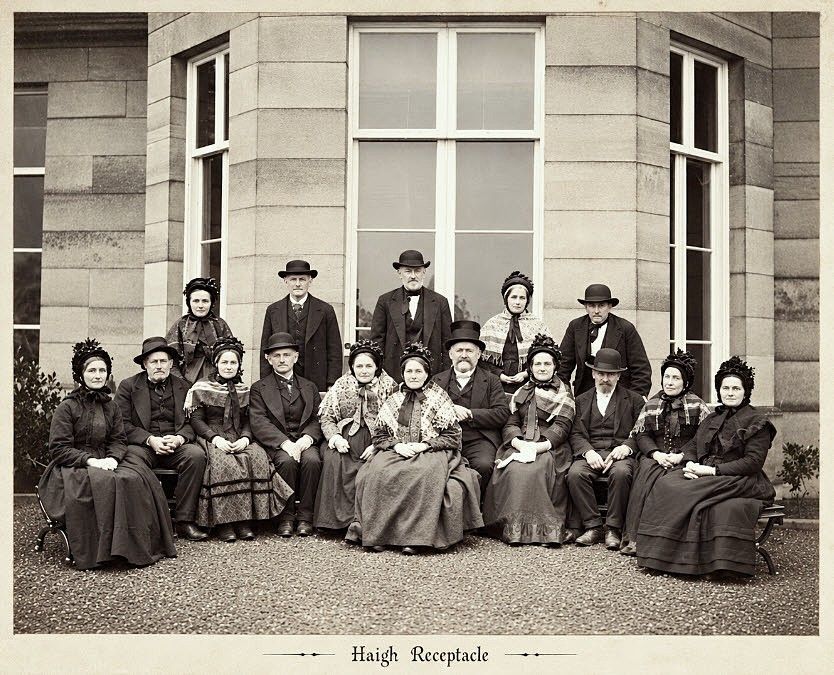 Residents visiting the Hall in the late 1890's
For workers whose earning capacity declined through age, accident or illness, charitable institutions could provide an important measure of support.
The Receptacle occupied a distinctive position within this landscape. It was neither a parish workhouse nor an ordinary collection of cottages. It was a privately endowed charitable foundation with its own property, income and system of administration.
Its name also reflected its purpose: a place intended to receive people in need of shelter and assistance.
Historic maps provide evidence of its continuing existence. It appeared as the Receptacle on the 1796 Haigh estate map, while nineteenth-century Ordnance Survey maps identified it as almshouses. The name Receptacle reappeared on later mapping.
The institution's survival through the nineteenth century is particularly significant given the substantial changes in poor relief following the Poor Law Amendment Act of 1834.
While the statutory poor relief system was transformed, the Receptacle continued as a separate charitable institution, preserving the intentions of its eighteenth-century founder.
The Receptacle in the Twentieth Century
The Receptacle survived long after the society in which it had been established had changed beyond recognition.
By the twentieth century, the development of old-age pensions, public assistance and eventually the welfare state had altered the circumstances of elderly people who might once have depended entirely upon charitable accommodation.
Nevertheless, the building continued to serve its residential purpose for much of the century.
Eventually its original use came to an end, and by the 1980s the Receptacle had fallen into dereliction.
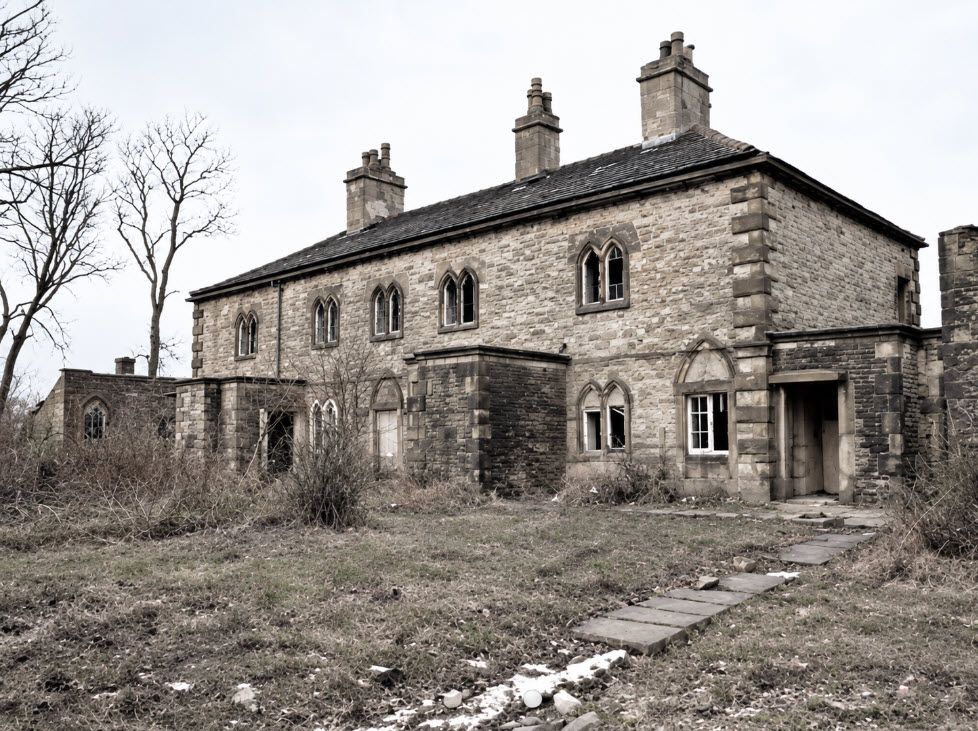
Fortunately, the historic building was not lost.
It was subsequently restored and converted into three private houses, retaining much of its distinctive eighteenth-century architectural character.
The Receptacle had been designated a Grade II listed building on 22 February 1967, recognising its special architectural and historic interest.
Its official listing describes the dressed-stone construction, pointed windows, hipped roof and other surviving features.
A Lasting Memorial to Dame Dorothy Bradshaigh
More than 250 years after its construction, the Receptacle remains a tangible reminder of a period when the welfare of the poor depended heavily upon private benefaction, religious institutions and the charitable responsibilities assumed by wealthy landowners.
Dame Dorothy Bradshaigh's achievement was not simply to erect a building. She sought to establish a permanent institution, with an income sufficient to maintain its inhabitants and preserve the property for future generations.
The Charity Commissioners' report demonstrates that her intentions were largely fulfilled, despite the legal complications that followed her death.
It also reveals the practical realities of operating such a charity: the appointment of residents, the payment of allowances, the provision of medical care, the maintenance of buildings and the continuing need for responsible financial management.
Perhaps the most significant aspect of the Receptacle's history is the evidence of the twenty people who lived there at the time of the investigation.
Their names are not recorded in the passages examined, but their circumstances emerge through the Commissioners' description of the institution. They were men and women drawn principally from Haigh, with others from Wigan and Aspull, including elderly married couples who were able to remain together.
For them, the Receptacle offered a modest home, a small income and some security in an age when poverty in old age could have devastating consequences.
Today, the building stands as one of the more unusual surviving monuments to the social history of Haigh and Wigan.
While Haigh Hall is remembered for its aristocratic associations, the Receptacle tells another, equally important story: that of the ordinary people whose lives were shaped by the estate and the charitable provision of its owners.
Dame Dorothy Bradshaigh's Receptacle deserves recognition not merely as an attractive historic building, but as an enduring memorial to more than two centuries of charitable provision in the Wigan district.
Sources:
Charity Commissioners Report for 1830. Link
Historic England
Wigan Council - Haigh Woodland Park historical assessment.
findmypast