George Worsley Adamson (1913–2005)
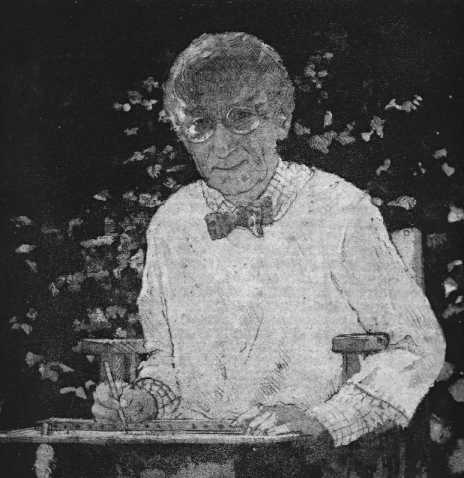
A Wigan Artist Who Achieved National Recognition
Although born in New York, George Worsley Adamson spent his formative years in Wigan, where he developed the artistic talents that would eventually establish him as one of Britain's respected illustrators, engravers and cartoonists. His association with the town extended beyond his childhood and education, for Wigan continued to provide subjects for some of his most interesting early works.
Adamson's drawings and engravings offer a fascinating glimpse of Wigan during the 1930s and 1940s, recording aspects of local life, entertainment and architecture through the eyes of an artist who knew the town intimately.
From New York to Upper Dicconson Street
George Worsley Adamson was born in the Bronx, New York, on 7 February 1913. His father, George William Adamson, was a Scottish-born engineer, while his mother, Mary Lydia Howard, came from Wigan.
The family's connection with the town was established long before George made it his home. In the autumn of 1913, while still a baby, he visited Wigan with his mother and elder sister, Marie.
Following the death of his mother in February 1921, George and his two sisters, Marie and Dorothy, travelled to England, arriving in Liverpool aboard the Caronia on 10 July 1921.
The children were taken into the care of their maternal aunts and settled at 24 Upper Dicconson Street, Wigan, with other members of the Howard family living nearby, including at number 26.

Their father remained in America, where he died in December 1922. George was therefore orphaned at the age of nine, and Wigan became the centre of his family life and upbringing.
Wigan School of Art
Adamson's artistic education began in Wigan. Although he initially considered architecture as a possible career, his ability as a draughtsman soon became evident.
In January 1930, aged sixteen, he enrolled as a part-time student at Wigan School of Art, becoming a full-time student in September of that year.
The school formed part of the educational facilities associated with Wigan Mining and Technical College, his training provided a thorough grounding in drawing, design and composition, skills that would remain fundamental to his later work as an engraver and illustrator.
He remained at Wigan School of Art until December 1934, when he continued his studies at Liverpool City School of Art, specialising in engraving, drypoint and aquatint.
His progress was considerable. In 1933, while still associated with Wigan, his work was accepted for exhibition at the Walker Art Gallery in Liverpool. By 1937, he had exhibited at the Royal Academy in London.
Wigan Through the Artist's Eyes
One of the most interesting aspects of Adamson's career is that he continued to use Wigan as a subject for his work.
His surviving drawings and prints provide an artistic record of a town that was undergoing considerable social and economic change.
Among his known Wigan subjects are The Savoy, Wigan (1937), Wigan Fair (1938) and Whit Monday, St Mary's, Wigan (1947).
These works reveal an interest in the everyday experiences of local people, from popular entertainment and traditional fairs to religious processions and familiar town buildings.
Wigan Fair, 1938
One of Adamson's most impressive local subjects is Wigan Fair, a detailed drawing dating from 1938.
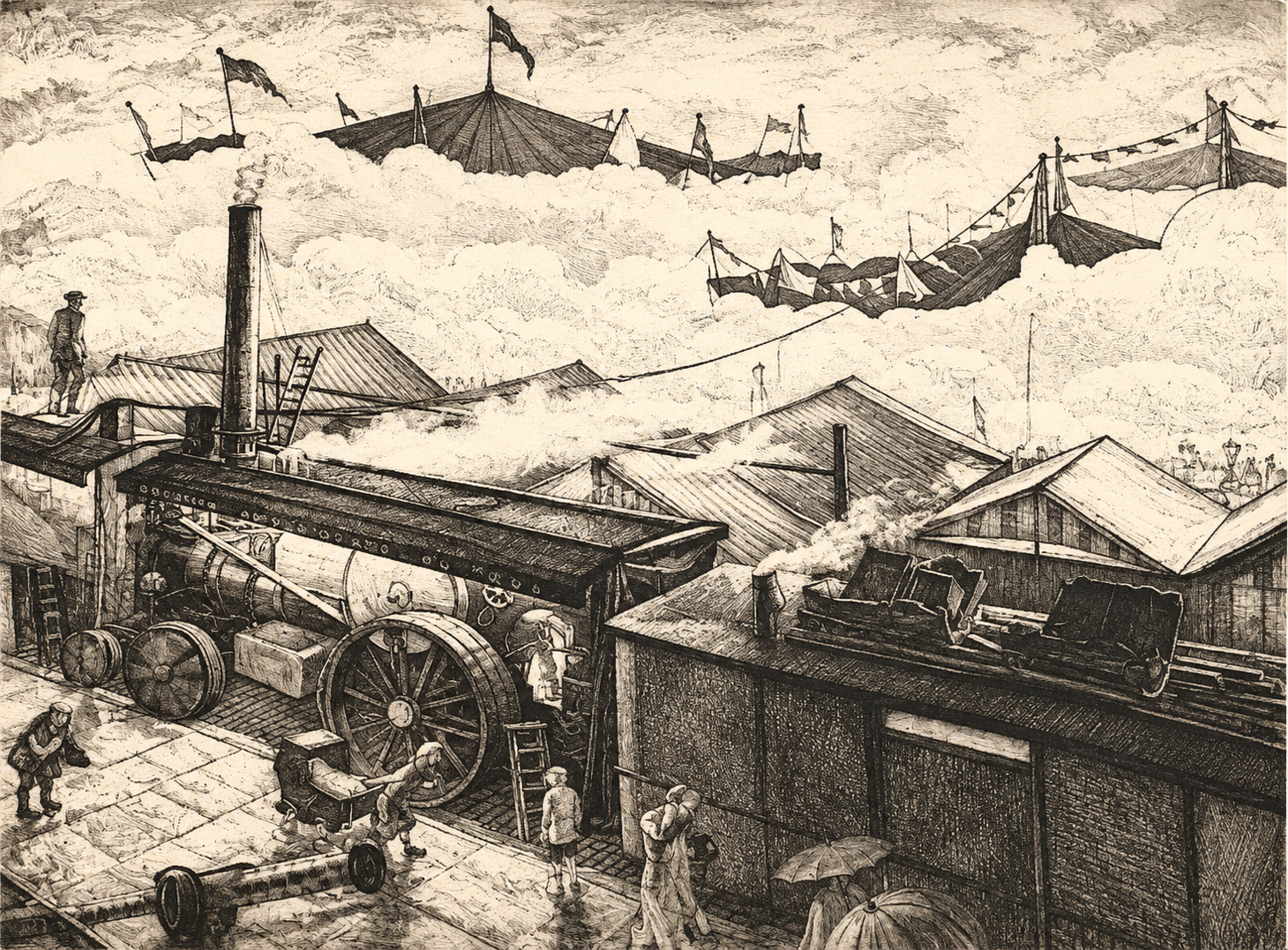
The composition captures the extraordinary activity of a traditional travelling fair, with a large steam-powered engine dominating the foreground. Around it are wooden structures, temporary buildings, canvas-covered attractions and the distinctive outlines of fairground equipment.
Small figures move between the machinery and stalls, providing a sense of scale and bringing the scene to life.The work is particularly interesting for its technical detail. Adamson's training as an engraver enabled him to depict the complicated machinery, textures and structures of the fairground with considerable precision.
The drawing also has a wider historical importance. Travelling fairs were once major events in the social calendar of industrial towns such as Wigan, providing entertainment and excitement for local families.
Adamson's depiction preserves something of that atmosphere, showing a fairground in which steam power, traditional amusements and temporary structures combined to create a distinctive spectacle.
The work was exhibited at the Royal Academy in 1939, an indication of the quality and significance of the young artist's achievement.
Other Wigan Subjects
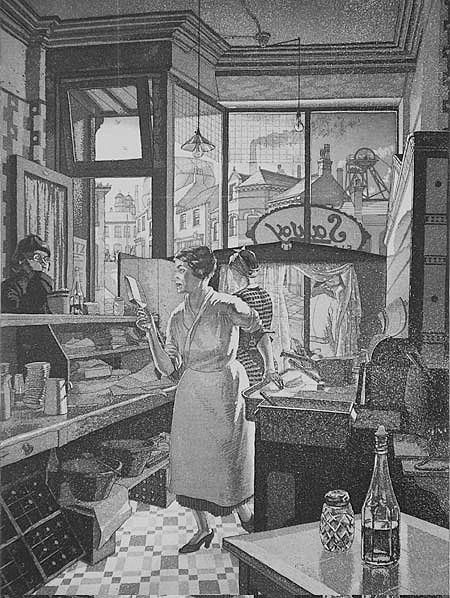
Adamson's The Savoy, Wigan, dated 1937, demonstrates his interest in the town and may have been his favourite "chippy" from Upper Dicconson Street.
Another particularly intriguing work is Whit Monday, St Mary's, Wigan, dated 1947. The subject recalls the importance of Whit Monday celebrations and religious processions in the town's social and religious life.
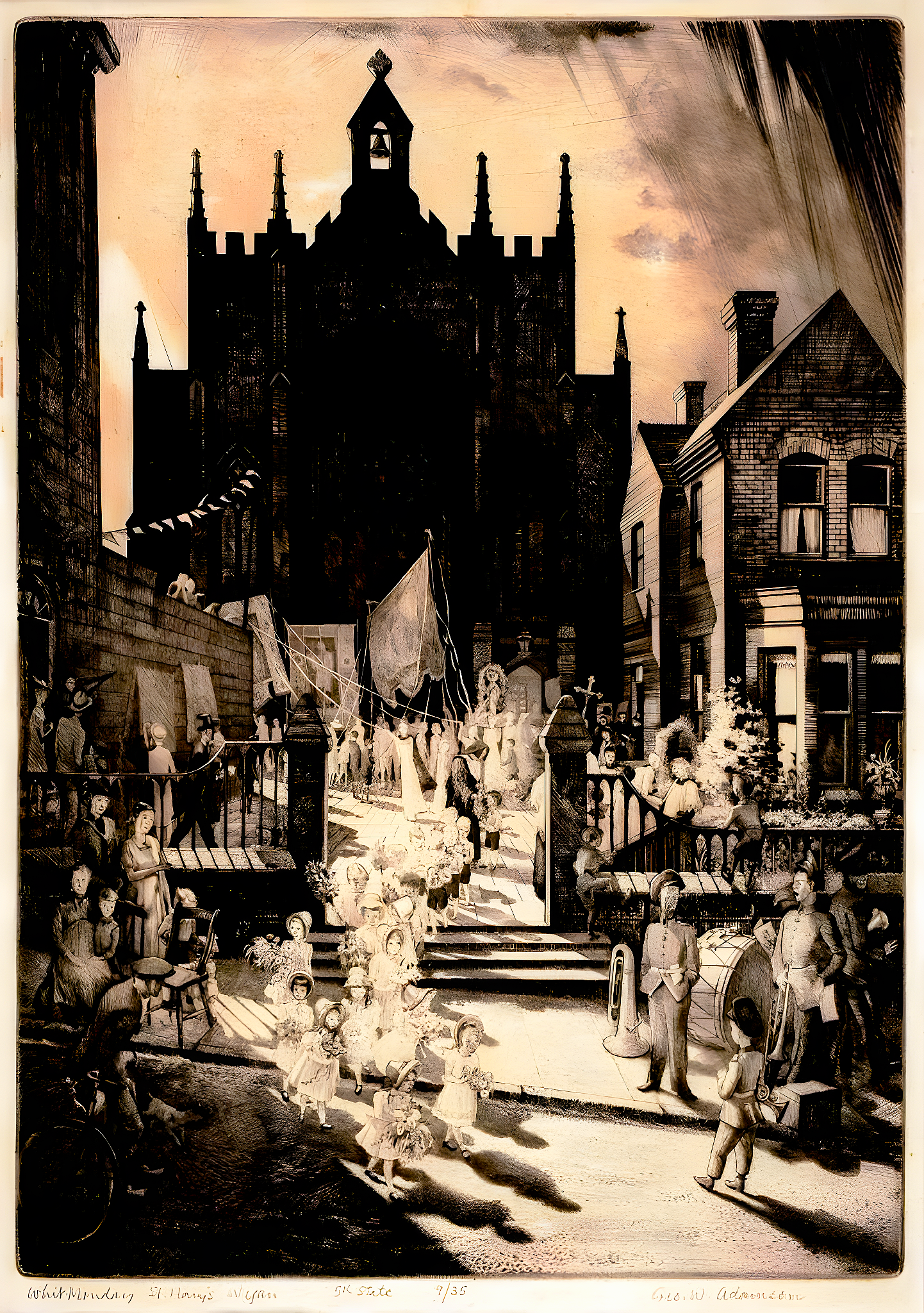
Such occasions were a prominent feature of Wigan's calendar, bringing together families, churches, schools and local communities.
His treatment of these subjects suggests that Wigan remained an important source of artistic inspiration even after he had left the town to pursue his professional career.
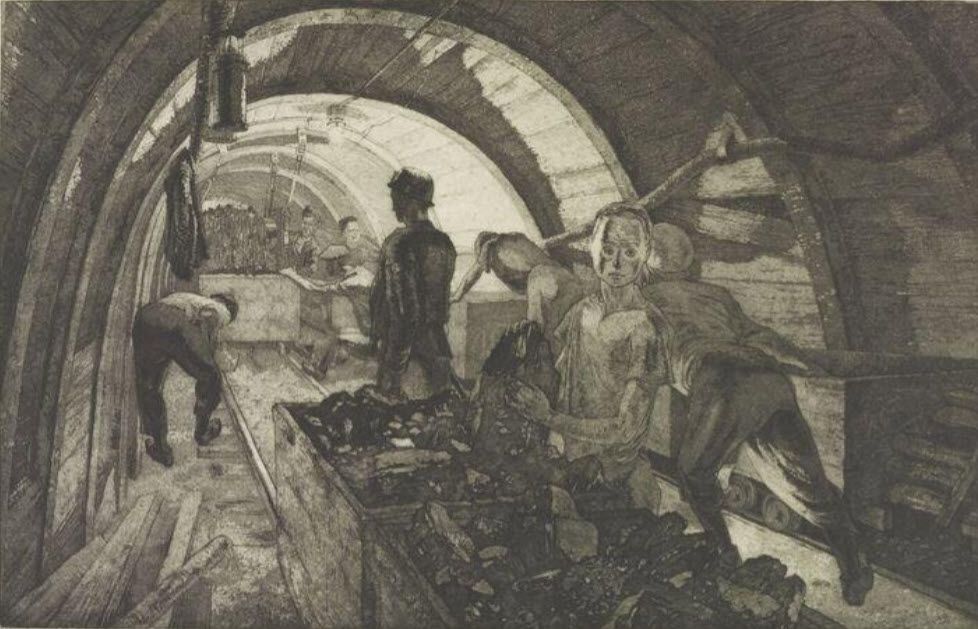
Another work, A Journey - Mineworkers in 1938, reputedly after spending eight hours down a coal mine.
From Wigan to National Recognition
Adamson's subsequent career took him far beyond Lancashire. During the Second World War he served in the Royal Air Force and became an official war artist.
After the war he taught at Exeter College of Art before establishing a successful career as an illustrator, engraver and cartoonist.
His work appeared regularly in Punch, and he illustrated numerous books, including works by Alan Garner, Ted Hughes and P. G. Wodehouse.
Despite his national reputation, his Wigan subjects remain an important part of his artistic legacy.
George Worsley Adamson died in Exeter on 5 March 2005, aged 92.
A Lasting Wigan Connection
George Worsley Adamson deserves recognition as one of the notable artists associated with Wigan during the 20th century.
His early life at Upper Dicconson Street, his education at Wigan School of Art and his depictions of local events and buildings provide a strong connection with the town
.His story also demonstrates the important role played by Wigan's educational institutions in nurturing artistic talent. From the classrooms of Wigan School of Art, Adamson progressed to exhibit at the Royal Academy and establish a distinguished career in British illustration.
Perhaps his most valuable contribution to Wigan's history is the collection of drawings and engravings through which he recorded the town as he remembered and experienced it.
Works such as Wigan Fair are not simply artistic achievements. They are also visual documents of a changing town, preserving scenes of everyday life that might otherwise have disappeared from memory.
George Worsley Adamson may have been born in New York, but his artistic journey began in Wigan.