The Mystery of the Georgian Clock
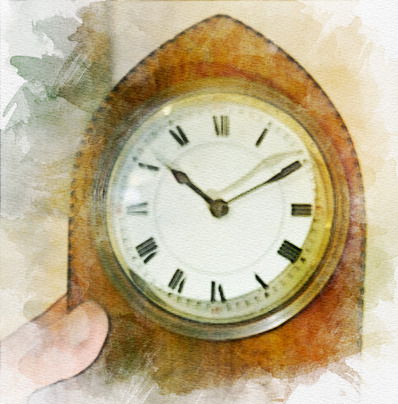
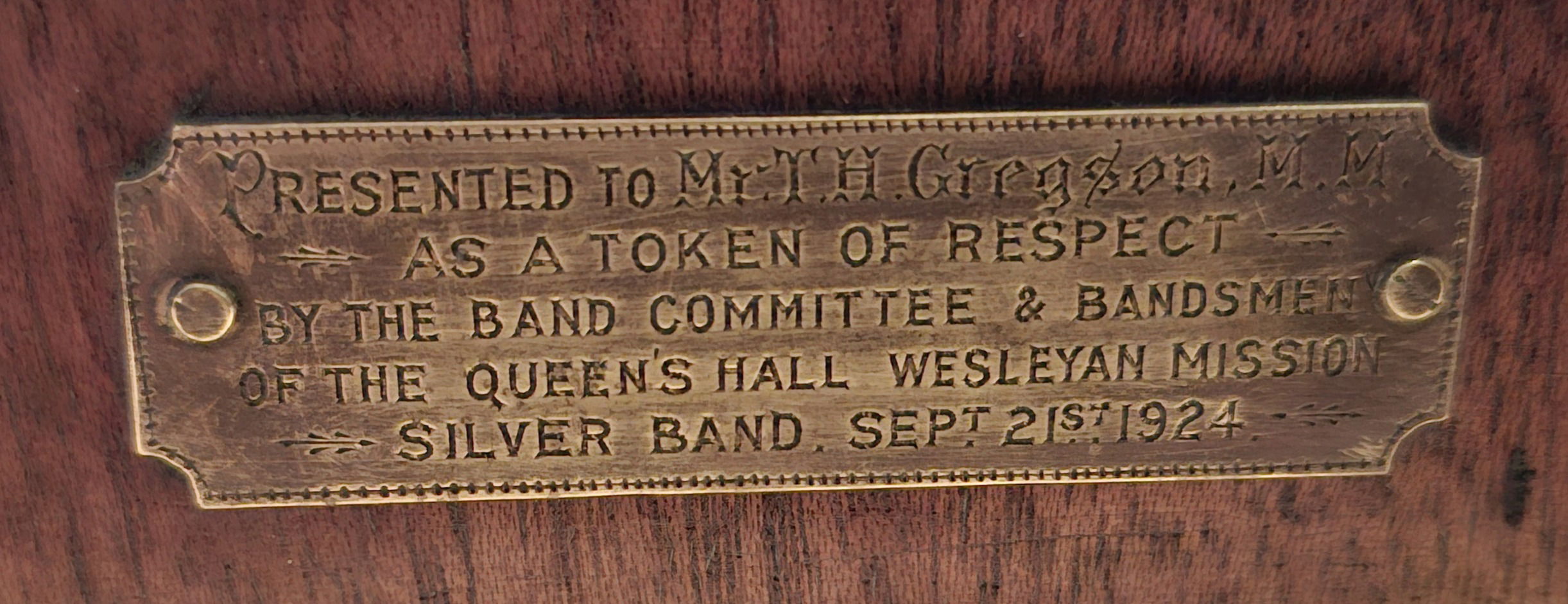
The Trust recently received an enquiry from Sjors Dorelrijers in the Netherlands, hoping to shed some light on his recent purchase of a Georgian clock that contained an inscription on a brass plaque which read.
PRESENTED TO Mr. T.H. GREGSON MM
AS A TOKEN OF RESPECT
BY THE BAND COMMITTEE & BANDSMEN
OF THE QUEENS HALL WESLEYAN MISSION
SILVER BAND SEPT 21st 1924
Thomas Henry Gregson was born on 17 March 1890 at 3 Wellington Street, Warrington, Lancashire, the youngest of seven children (five girls and two boys) born to William, a baker by trade and Janet Gregson. He was baptised at Bold Street Methodist Church on 6 April of that year.
The 1911 census shows that 21 year old Thomas was a grocer’s assistant. and was living with his parents at 69 Ellesmere Street in Warrington, his brother and sisters all having left home. He was also superintendent of the Ellesmere Street Wesleyan Sunday School.
He then trained at Cliff College in Calver, Derbyshire for the Wesleyan Ministry and after a two year residency took up a missionary post in Liverpool which he held for 18 months. In 1915 he took up a post of Wesleyan missionary in Australia, in the town of Mansfield, 75 miles north east of Melbourne.
He set sail from London on 24 June 1915, aboard the SS Benalla, a migrant ship carrying over 800 passengers. In July the vessel caught fire in her No. 2 hold while off the coast of South Africa. The crew fought the blaze for three days and nights and after a harrowing time the ship eventually managed to reach Durban safely.
Thomas who was of a nervous disposition was greatly affected by the incident and after a breakdown in health he resigned his post after six months and returned to England, arriving home on 3 February 1916. The authorities in Australia had made it a rule not to give anyone his passport unless he had promised to join the army. So on his return Thomas was called before an Army Board.
He explained that he was a Methodist Home Minister, and he had a conscientious objection to combatant service, either to the taking of life or the handling of weapons. As a teacher of religion he could not reconcile warfare with his spiritual convictions, the acceptance of broader life in a spiritual sense had led to these convictions which he had held for six years. He added that he was willing to serve if he wasn’t asked to kill anybody. After consultation the Chairman of the panel, Mr. W Mather declared that they had granted his request and he would be put down for service he could conscientiously do.
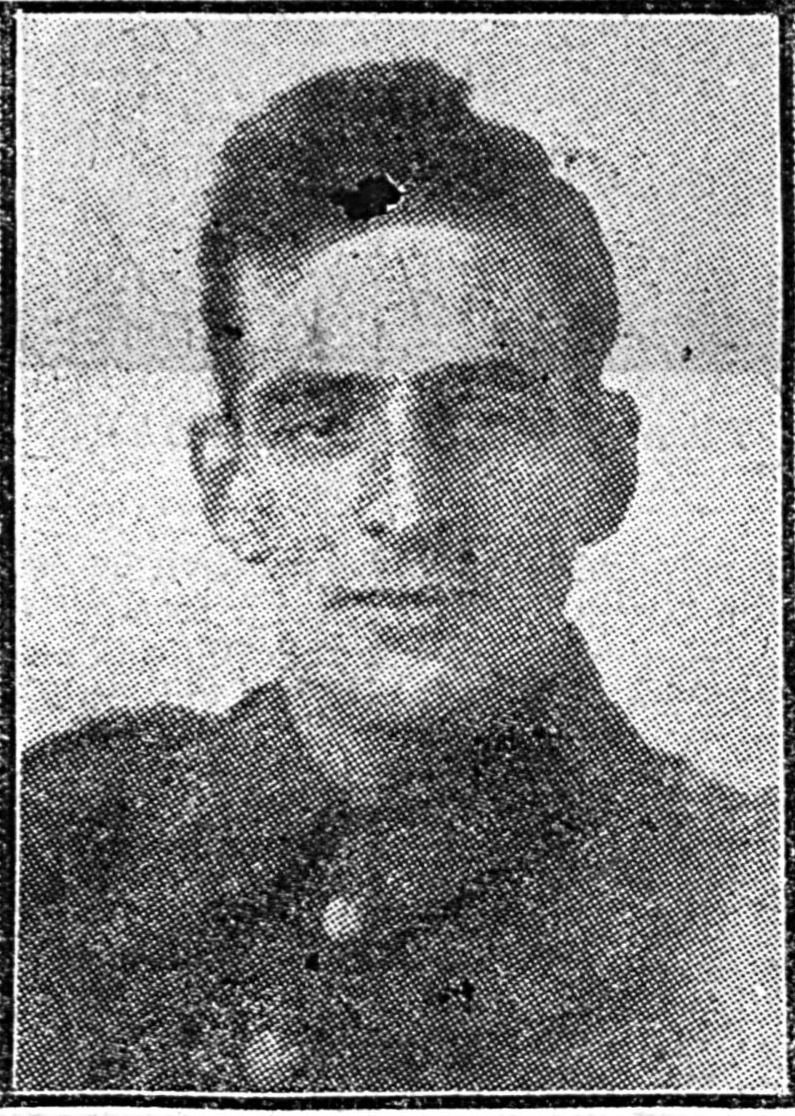
CQMS Thomas Henry Gregson MM (1890-1981)
Thomas’s WW1 army service records survived but are incomplete owing to fire and water damage sustained during an air raid on London in the Blitz of September 1940, therefore some relevant information is missing.
On 14 February, with the service number of 202229 he was attested into the 2/4th Battalion (Prince of Wales) South Lancashire Regiment, a second line infantry unit whose headquarters was at Orford Barracks in his home town of Warrington. He was placed on the Army Reserve but on 18 March was mobilised and posted to his battalion. For the next year the regiment trained in various locations in England. Promotion quickly followed and he was promoted to Lance Corporal on 12 October 1916.
On 16 February 1917 the battalion embarked at Folkestone, landing at 11:30 am in Boulogne to enter the theatre of war in France. The battalion underwent their first tour of the trenches on 1 March 1917, in the Bois Grenier sector near the Belgian border, suffering two killed and four wounded. He was promoted to Corporal on 1 April 1917 and on 14 May 1917 promoted to the rank of acting unpaid Sergeant.
On 1 August 1917 ‘D’ Company of the regiment successfully raided the enemy trenches in the Rue de Bois sub sector, suffering four killed and 16 wounded. In this action Thomas was wounded, receiving a gun shot wound to the head. As he was a noncombatant we have to presume that he was a runner or a stretcher bearer. The same day he was promoted to the rank of substantive Sergeant for gallantry in the field.
Three days later on the 4th of August 1917 Thomas was awarded the Military Medal for gallantry and devotion to duty in action. The casualty evacuation chain saw him back in a military hospital in Winchester, Hampshire five days after being wounded in action.
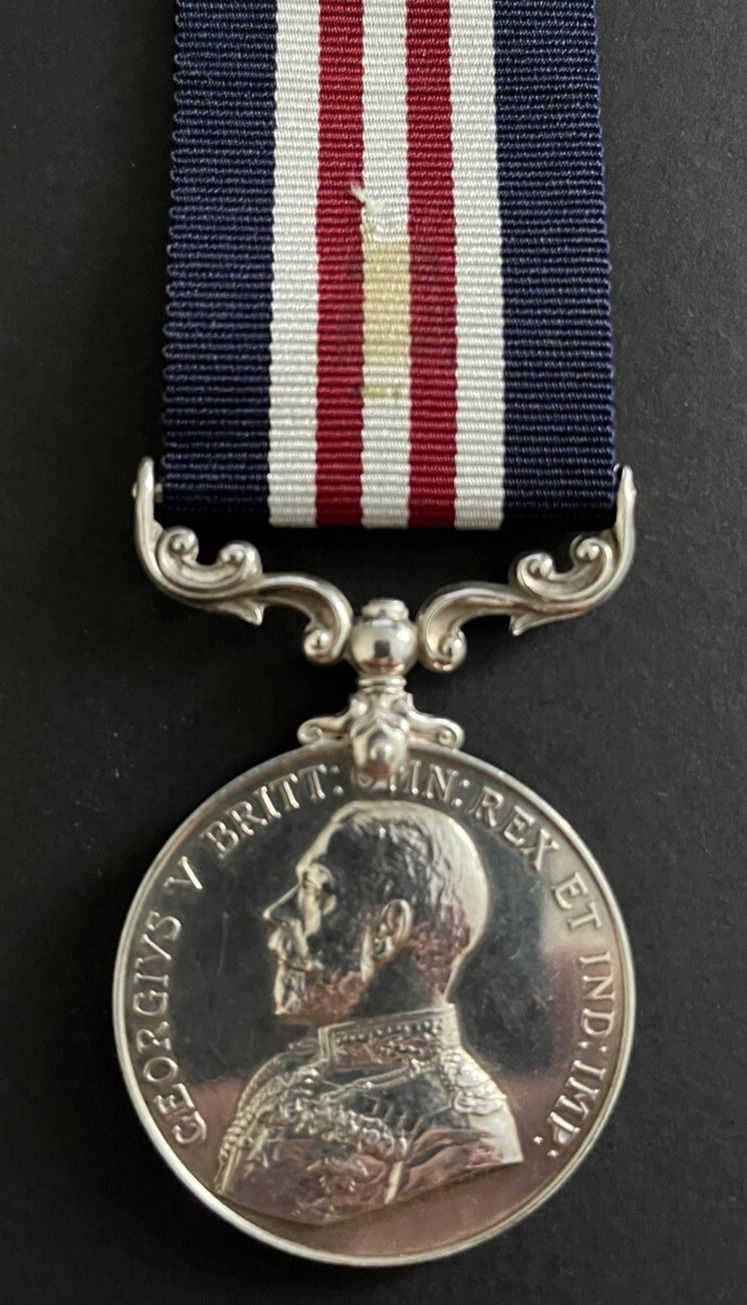
Great War Military Medal
Owing to his wounds Thomas was not deployed on active service overseas again, on 4 June 1918 he was posted to the 3rd Battalion of his regiment. which served as a Special Reserve and Training unit based in England primarily conducting coast defence at Crosby near Liverpool and Barrow-in-Furness. He was appointed Acting Company Quarter Master Sergeant in charge of stores and equipment on 12 February 1919.
Thomas was finally discharged from the army on 15 May 1919 at Shrewsbury in Shropshire, and placed on the Class Z Reserve list, receiving a 30% disability war pension. As well as the Military Medal he was awarded the British War Medal and the Victory Medal. Before his demobilisation he had requested reimbursement of his fare back to England from Australia as it was practice that anyone who had joined the army from overseas was eligible for a free passage. He was paid the sum of £16. 2 shillings and 4 pence.
On leaving the army he took up a position of Lay Pastor at the Wesleyan Methodist Reform Church in Doncaster, South Yorkshire. In 1920 Thomas was married in Warrington to Isabella Lee, who was born in nearby Widnes. the couple were to remain childless.
Following their marriage they moved to Hull in East Yorkshire where Thomas took up a position of Lay Preacher at the Queens Hall Wesleyan Mission in Alfred Gelder Street. (The church was closed in 1960 and the building in 1965). While fulfilling this role he was also a student at Hull University, Thomas and Isabella lodged with Arthur Loughborough, a schoolmaster in Barton on Humber, across the estuary in Lincolnshire.
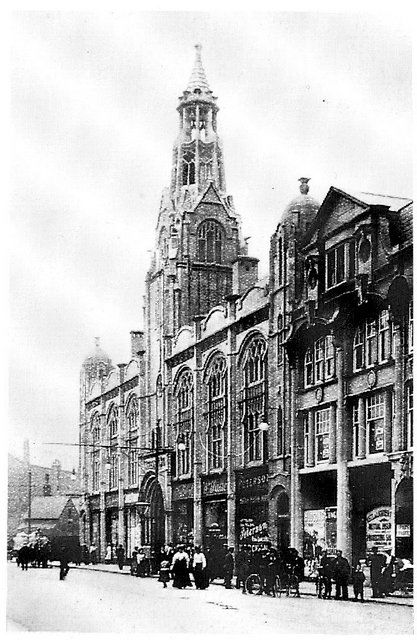
Queens Hall Wesleyan Mission, Alfred Gelder St, Hull
On 10 September 1924 Thomas was presented with a clock by the Queens Hall Silver Band prior to his departure to Paisley, Renfrewshire, in Scotland where he trained for ordination into the priesthood, the couple lived at 39 Albion Street.
Thomas and Isabella spent six years in Scotland before retuning back to Yorkshire where he was appointed Minister at Bentley, Doncaster. It was about this time that the three main Methodist churches, Wesleyan, Primitive, and United came together to form the Methodist Church.
Apart from a period between 1935 and 1937 when he was stationed in Handsworth, Birmingham, Thomas spent the remainder of his career preaching on the Yorkshire Methodist circuit. Including Doncaster and Rotherham in South Yorkshire, and various missions in North Yorkshire including Middlesborough, Masham, Pickering and finally Selby up to 1957.
Rev Thomas Henry Gregson MM died on 11 November 1981 at the Connell Court Care Home, 20-22 Weld Road, Southport, Lancashire, aged 91. His wife Isabella had preceeded him dying in 1977 in Kendal, Cumbria, aged 88.
Although the clock proved to have no connection with Wigan, it is still an interesting story of a brave man who stood by his religious principles.
Graham Taylor 2026
Sources
Ancestry, British Newspaper Archive, London Gazette, National Archives, Wikipedia