A Wigan Poem - Written on The Somme in May 1918.
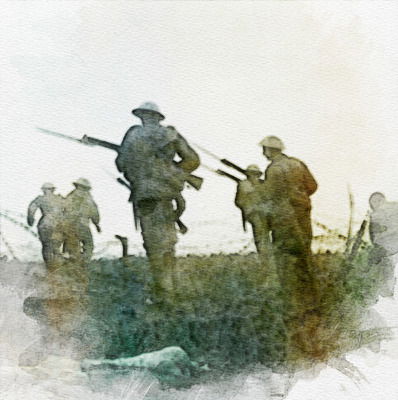
Wigan Home-Thoughts, from France
Written on the Somme, May 1918
by Donald Alexander Mackenzie.
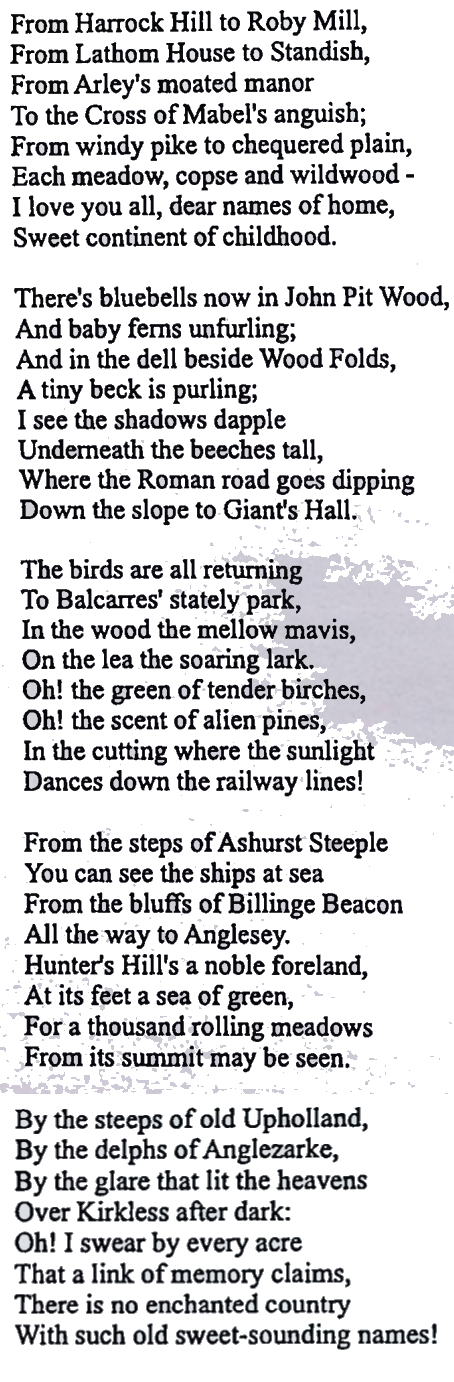
The Poem
The Poet
Donald Alexander Mackenzie, the son of Scottish parents, was born on 1st June 1889 at 14 Freckleton Street, Wigan. He was the youngest of the five children of an agent for Singers, the sewing-machine manufacturers. The family then moved to 8 Springfield Street, Wigan, where, together with boarders, they were living at the time of the 1891 census. By 1903 they had moved to Dornoch House, 105 Dicconson Street, Wigan.
Young Mackenzie was educated at the Wesleyan School, and then at Wigan Grammar School, which he entered in 1900. He became a pupil teacher in 1905, and gained the Teacher's Preliminary Certificate with distinctions in English, French, and Latin in 1907. He also matriculated for Manchester Victoria University in the first division with advanced papers in English Literature and English History, and won the Sir Francis Powell Exhibition, which provided him with the financial means to attend university. He obtained a B.A. (Hons) Class II in English Language and Literature in 1910, and was awarded an M.A. in 1911.
He embarked on a career as a teacher, first at Carre's Grammar School, Sleaford, Lincolnshire, from 1910, and then at the Central Secondary School, Sheffield, Yorkshire, from 1913.
His teaching career was interrupted by the First World War. He joined the Territorial Army and entered the Royal Artillery, serving with the Royal Field Artillery in 317 (Northumberland) Brigade of the 63rd (Royal Naval) Division, fighting on the Western Front. He was commissioned as a second lieutenant in 1916, and full lieutenant in 1918, and he ended the war as an acting captain. Meanwhile, he was awarded the Military Cross. His citation reads:
For conspicuous gallantry and devotion to duty. When the limbers and teams of the battery were heavily shelled, he prevented more casualties by the prompt and courageous assistance he rendered. Later, when an enemy aeroplane bombed and set fire to the ammunition dump, he extinguished the fire whilst the aeroplane was still overhead. Throughout the operations by his coolness under fire he set a fine example to all.
After the war he returned to Sheffield to become the City Secretary for Higher Education, and then left for London to become Assistant Editor of the Teachers' World. It was during this time that he returned to Wigan as guest of honour at the Wigan Grammar School Old Boys'Association Annual Dinner in 1935.
He declared that:
Once he was a teacher, but now he was a journalist, and he did not think that he would ever change, for it was the only career in which an entirely unknown person, provided he had resource and nerve, could meet the famous men and women of the day.
He recalled his teachers who had given him his first love of poetry. He then went on to explain that:
Once he asked Mr Arnold Bennett [the novelist who set many of his books in the industrial landscape of the Potteries] why no poet had immortalised industrial Britain. His reply was that it was too desolate and ugly. [Mackenzie] did not agree, especially as regards Wigan and its surroundings. Nature showed all her glories in and about Wigan just as in any other place in the world. He hoped he would convey what he wished to express in the following poem, which he wrote in 1918, when on the Somme.
He then read the poem published here. He seems to have published no other poems.
In 1944, he went into films, becoming Principal of Gaumont British Education Division, but when the studio closed this department in 1949 he was made redundant and became a freelance journalist. At this time he was living in Ashtead, Surrey.
He died at Worthing Hospital on 22 October 1971.
Below you can download the original publication, with additional material and comments.