A Monkey up a Stick
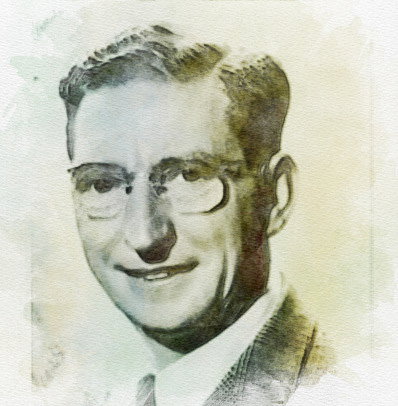
Remembering Frank Randle
J A "Tony" Hilton
 This formatted, image-free Word edition has been prepared from a scanned copy of the original booklet. The wording has been retained as closely as the source permits, with obvious OCR errors and spacing corrected. Unable to produce the images.
Preface
Do you remember Frank Randle? Born in Wigan over a hundred years ago. he was a comedian who played the theatres of Blackpool and the North in the middle of the last century. Gracie Fields declared him 'The greatest character comedian of the variety stage'.
This memoir is written to celebrate the centenary of the birth of Frank Randle, comedian (1901-1957). The profits from its sale will go towards placing a commemorative plaque on St John's School. Wigan Rd. New Springs, near where Randle was born al 50 Wigan Rd. Aspull. Wigan.
I am grateful to all those who have helped with this project: the Aspull and Haigh Historical Society, the Rev. Mr J.E.Bassett. the staff of Carleton Cemetery. Mr J. Crawshaw. Miss A. M. Cunningham. Mr J. Cunningham. Miss D.Gladwin. Mr A. Leigh. Miss E.T.Lowcson. Mr J. McDermott, the governors of St John's School. Mr G. Shryhane. Mr T. Smith, the staff of Wigan and Leigh Register Office, and Mr W. Wright. The opinions expressed in this memoir are mine and not necessarily theirs.
J.A.Hilton Wigan Wigan Wakes 2001
Memories
Do you remember Frank Randle? I think I do. I think I do. but my memoir is faulty. and much that we think we know about Randle is based on reminiscence, where memory merges with myth.
I remember Frank Randle performing at the Wigan Hippodrome with his catch phrase 'Get off my foot'. I remember the Hippodrome before it burnt down, but now even the inscribed chimney that survived the fire has been demolished.
I remember Frank Randle as the eponymous hero of the strip cartoon in Film Fun. I remember my parents sending me to bed with his catch phrase 'Get up them stairs'. but not in the sense that he meant it.
I remember someone who remembered drinking with him in the Shakespeare Hotel near the Hippodrome in Wigan. I know someone who remembers him playing the trumpet until his trousers fell down.
I know someone who remembers seeing him perform at a theatre in Preston. The curtain opened to reveal Frank under a green spotlight. He let the silence fill with laughter and die down. and then he said - memories of Shakespeare - "I am thy father's giblets'', and the curtain closed again to more laughter.
The Boyhood of Randle
Let us begin with authenticated historical fact before we explore the memories of his boyhood. I have before me a ‘certified copy of an entry of birth' from the Wigan and Leigh Register Office. He was born Arthur Hughes on 30 January 1901 at 50 Wigan Rd. |New Springs) Aspull. Wigan, the son of Rhoda Hughes. ‘Housekeeper (Domestic Servant)'. His father's name is absent. In other words he was illegitimate. For the rest of his childhood we must rely on anecdote.
His mother went to Blackpool to find work as a barmaid and perhaps to escape the gossip surrounding this illegitimate birth. She left her infant son with her sister Florric at Cale Lane. New Springs. From there his mother took him to Annie Heath at 4 New Square. Standishgate. Wigan (New Square was in the angle between Standishgate and Mesnes St - it is now a car park), and he became Arthur Heath.
He attended St George's School (the building is now a nursing home). George Formby is said to have been a childhood friend. It is not unlikely, for they were contemporaries and Formby was born (the site marked by a plaque on Central Park Way) a stone’s throw away from St George's School, but it also looks like a pious hope that Wigan's two great contemporary comedians should have been childhood friends. Arthur Hughes alias Heath is also said to have lived at 429 Warrington Rd. Spring View. Lower Ince. Wigan.
He used to go to visit his mother at Blackpool, where, imitating Charlie Chaplin, he would busk for pennies on the sands. He is said to have always spent his train fare home (unlikely, as a return ticket would have been cheaper than two singles), and had to walk the thirty miles back to Wigan.
He is also said to have gained his first experience on the stage at Wigan Little Theatre, again a possibility, but more like a pious legend.
He left school at the age of fourteen and got a job in a mill. At the end of the day, the foreman told him to go home to sleep. ‘And have a long sleep too,’ replied little Arthur Heath, ‘because I’m not coming back.’ When, years later, he became famous, he would seek out his childhood friends in the bars of Wigan.
He was also heroically generous to the poor, giving away the coat off his back. ‘If they’re ragged and merry,’ he said, ‘they’re welcome.’ He loved ordinary people, and they loved him in return.
Meanwhile, his mother married Dick McEvoy, an ex-soldier who took a public house in Blackpool, so Arthur Heath joined them there and became Arthur McEvoy.
From Wigan Pier to Blackpool Pier
The railway took young Arthur Hughes alias Heath From Wigan Pier to Blackpool Pier.
It took him and most of his fellow Wiganers there annually every Wakes week (the traditional annual holiday when the town virtually closed down), as it took the workers of the other Northern mill towns. It took him from a tow n oF cotton, coal, iron and steel, and engineering.
However. Wigan's boom years ended with the First World War. and when Orwell visited the town in 1936 to write The Road to Wigan Pier a third of its population of 187.000 was unemployed.
Now that Wigan Pier has become a centre for heritage tourism, let us not Forget that it began as a joke, given currency if not coined by George Formby Senior, a laugh at the contrast between an inland industrial pier and the seaside pleasure piers.
There are critics who protest that the Formbys. Randle, and Orwell brought Wigan into disrepute, but the comedians alleviated and the writer denounced the harsh living and working conditions of the times. It is their humourless and stupid critics who bring the town into disrepute.
The railway took Arthur to a seaside town dedicated to pleasure, where, according to the Morning Post. you could have ‘more fun for less money than anywhere else'. It had a beach, a promenade, three piers with their theatres, and the Tower. The annual Illuminations began in 1912.
Its visitors steadily increased from one million in 1900 to eight millions by 1960. They came For sea and sand. Fresh air and fun. booze and laughter, sex and sin. as portrayed in Stanley Houghton's Hindle Wakes.
The Making of a Comedian
In Blackpool, Arthur McEvoy did various jobs: bottle-washer, waiter, shop assistant, and tram-conductor. He also frequented a gym where he learnt boxing. wrestling, and acrobatics. It was this last activity that took him into show business.
He joined a troupe of acrobats, and changed his name to Arthur Twist. He became the comic partner in the acrobatic act. and it was then, the better to pull faces, that he had all his teeth removed and his hair dyed bright red.
It was while touring as an acrobat that he met another artiste. Eva Delaney, by whom he had an illegitimate son. another Arthur who took his mother's surname.
However, in 1927 at the Wigan Hippodrome he met another performer. Connie, known as 'Queenie'. May. and married her.
While still working as an acrobat he was given his chance to fill in as a comedian, and never looked back.
Meanwhile. Arthur Twist changed his name again, for the last time, to Frank Randle. In 1935 he joined George Formby in a show. Shout for Joy. which opened at the Blackpool Opera House. Randle then went on tour with the show, leaving Formby in Blackpool.
The following year Randle and Formby again appeared in a show at Blackpool. Formby in the first half and Randle in the second. The BBC broadcast highlights of the first half, but ignored the second.
The next night Randle appeared on stage, and declared. 'Ladies and gentlemen, it is perfectly clear that George Formby is the only star of importance in this show, so George Formby can entertain you now', and walked off.
It was an augury of things to come, the touchy pride, the temper..the walkouts, and the violence.
The Art of Comedy
Randle played three main characters - the Old Boatman of 'Any More for Sailing', the Grandpa of'Grandpa's Birthday’. and the Old Hiker - but there were others, such as Buttons in pantomime and Private Randle in his films.
He had his catch phrases: 'A hot un’. 'Get off my foot'. 'Get up them stairs'. ‘By. we’ve supped some stuff tonight', and 'See what I've found’.
He starred in and produced his own shows based at the various Blackpool theatres - the Piers, the Queen’s, the Opera House - and took them on tour as ‘Randle’s Scandals'.
He had his company of stooges: Dan Young, Arthur White. Leslie Gould. Rat Williams. Kevin and Charles Peter. Arthur Cannon. Ernie Dale. Sonny Roy (whom I think I remember seeing on stage). Stan Stafford. Paul Wood. Raymond Waller, and Gus Aubrey.
The Manchester Guardian snootily called Randle the ‘master of the single entendre', but he maintained. "I'm vulgar, but not filthy".
He would look down the inside of his shorts, and exclaim. 'I can see... I can see... I can see my feet!’ Unlike some modern comedians, including some so- called alternative comedians who practise an alternative to comedy, he would usually avoid obscene language on stage. but his comedj’ often depended on the possibility of obscenity: "Well. I'll go to Bucklebury!'. ‘I'll run ‘ent walk ‘em. jump 'em. fight 'em aye'. '1 goes to bed early and I goes to sleep. There's no monkey business about me'.
The authorities did their best to limit Randle's freedom of vulgar expression. In one pantomime he turned to the audience, and said. 'Ladies and gentlemen. I am now supposed to say "Hello Cinders, I've come to cut off your water”, but the buggers won't let me'. In 1951 his show at the Blackpool Opera House was banned for the following exchange:-
[Randle chalks F on a blackboard) Stooge: It's a K_ Randle: Why is it even’ time I write F you see K?
In retaliation Randle hired a plane and bombarded Blackpool with toilet rolls. On another occasion Randle appeared in evening dress after the finale, and pronounced the following defence:
Ladies and gentlemen, you have seen that the little show we have presented for you this season has been under a great deal of criticism. You have seen that certain citizens, some of them quite eminent, have seen fit to call our performance 'filthy', 'obscene'. 'offensive', and that may well be their opinion but I come to you. ladies and gentlemen, and ask you to be my final judges.
I am. like you. a simple man bom of simple folk, a man of the industrial North of England My pleasures are simple - my packet of Woodbines, my glass of Guinness, the simple joys of the seasons. Simple people of our kind understand the facts of life in a way that many of our critics do not. You will know that my little bits of fun are founded upon the facts of life and. because you understand life and the realities of life. I ask you to be my judges. Is my little show obscene?
Is our little entertainment disgusting? [Cries of "No'' etc] Thank you, thank you. ladies and gentlemen for your comfort and encouragement.
The same game of threatening to break the rules, of pretending injured innocence, was played by his contemporaries George Formby - "With my little stick of Blackpool rock'' - and Max Miller - "Mary had a little bear to which she was so kind. I often see her bear in front....''.
It is the humour of the seaside saucy postcard cartoonists, like Donald McGill: on the beach a man's vast ale belly hides the little boy sat beneath and the man says. 'I can't find my little Willy'. It is perhaps a peculiarly English tradition carried on by the ’Carn On' Films:
Cleopatra [Amanda Barrie]: So you are the great Caesar? Caesar [Kenneth Williams]: Ah! You recognise me. Cleopatra: I’ve seen your bust. Caesar: 1 wish I could say the same.
The ‘Carry On’ team knew where their roots lay: Carry On Cleo begins among ‘the simple people of Coccium [Wigan],’ and in Carry On Up The Khyber or The British Position in India there is a missionary, played by Peter Butterworth, who runs the Wigan Mission to Fallen Women.
Those who cannot remember Randle but have attended one of Ken Dodd's live shows will know the rapport between comedian and audience, the irrepressible personality, the crescendo of laughter. Little survives beyond anecdote and memory and the odd recording to remind us of Randle's stage act, but there are the films. One or two can still occasionally be seen on television, and others are traded by what Nuttall calls 'Pennine gnomes'.
Formby's films on video can be purchased in the shops, but not Randle's. They were made cheaply, and it shows. They fall between the two stools of cinema and music hall, but occasionally they burst into inspired life. Perhaps the best example is in his last film It's a Grand Life. The scene is based on the following exchange in pantomime, which sails close to the wind:
Buttons [Randle]: What's the matter. Cinders? Why are you crying? Cinders [Gus Aubrey]: Oh Buttons. I've been thwarted ['thwarted' is pronounced to rhyme with 'parted', because it rhymes with a vulgar expression] Buttons: You’ve done what? Cinders: Thwarted. Buttons: Ech. never mind. I'll open a window. Cinders: Have you ever been thwarted. Buttons? Buttons: Never stop, never stop. It's this gassy ale. | A long, low bugle note]
In the film the vulgarity is less obvious, but the absurd dialogue rises to a Shakespearean climax:
Stooge: Why fling thy thwarts in my face? Randle: What? Stooge: Why fling thy thwarts in my face? Randle: Thwarts? Why fling my thwarts in thy face? Stooge: Yes. Randle: I never flung a thwart in anybody's face. Stooge: You know his thwarts have a powerful sting Randle: I didst not know I stung him with my thwarts. Stooge: Why? Can't you tell me when you're going to thwart me? Randle: Thou must let me know the next time I thwart thee, for surely thou wouldst not stop me from thwarting thee. wouldst thou? Stooge: No. Thwart away if it makes thee happy. Randle: Thank you. So be it. To thwart or not to thwart, that is the question.
Richly Blessed
At the height of his career Randle. earning £1.000 a week, was the highest paid comedian in the North, if not in England.
He moved with his wife and mother through a succession of ever-grander houses at Blackpool, culminating in Craig Royston.
He had his own yacht, the Mamuuna. moored at the South Pier. He drove fast cars. Lagondas. Bentleys. MGs. at fast speeds, a frantic eighty miles an hour, with a crate of Guinness, from which he liberally imbibed, under the front seat.
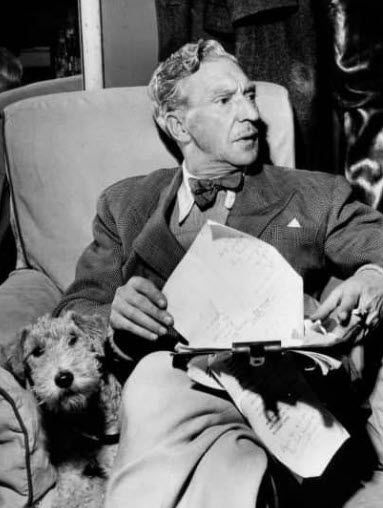
He had his show business friends, including the Irish tenor. Josef Locke. who appeared in his films, but he had an intense and increasing hatred of people in authority.
Attending a civic reception in his honour at Blackpool, when the mayor introduced his wife. Randle remarked 'Well that's your f-ing fault, old pal’.
Always unpredictable and a heavy drinker, he became increasingly violent, carrying an axe at rehearsals lest the producer dare try to direct him. and when the management offended him, which became more easy and frequent he smashed up his dressing room or set fire to the scenery.
He believed that 'The biggest man in the world was born in a stable’. At some stage he seems to have become a Roman Catholic like his wife.
He died of gastro-enteritis. the result of his drinking, on 7 July 1957. His Requiem Mass was celebrated at Holy Family church. North Shore. Blackpool, and he was buried in Carleton cemetery at Blackpool. His wife found a verse in his wallet and had it inscribed on his tombstone, which reads:
O SACRED HEART OF JESUS HAVE MERCY ON THE SOUL OF FRANK RANDLE (ARTHUR MCEVOY) THE BELOVED HUSBAND OF QUEENIE. AND SON OF RHODA. WHO DIED 7th JULY 1957 IN HIS 56th YEAR. MANY WILL REMEMBER HIM. I GOT NOTHING THAT I ASKED FOR BUT EVERYTHING I HAD HOPED FOR. DESPITE MYSELF MY PRAYERS WERE ANSWERED. I WAS AMONG ALL MEN RICHLY BLESSED.
The Old Hiker
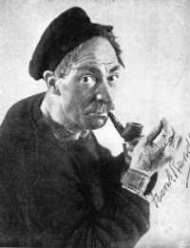
You may remember his act as the Old Hiker. Here is a transcript of a recording made in Blackpool in the late 1940s. Whether you remember him or not. you can imagine him. a toothless gargoyle, a life-size Mr Punch, a flatulent Lancastrian satyr, with a few strands of red hair sticking up on his balding head, eyes popping, limbs flapping, a huge phallic staff in one hand, a bottle of beer in the other, a muffler round his neck a bugle slung from his shoulder, baggy shorts, and massive boots.
The transcript is written in standard English but you must imagine the words delivered in a broad Lancashire accent the 'Ayes' and 'Echs' a barbaric continuum erupting into burps and belches. Editorial explanations are in square brackets.
So this is Oswaldtwistle. is it? [It was presumably Oswaldtwistle Wakes and the inhabitants of the town were in the theatre.] By gum. there's a cheeky kid up there. He just spotted me. He comes running to his mother. "Come here mother, there's a monkey up a stick". Aye...Well...I've walked through Europe. Earup. Ireup. Shutup. Wallop, lollop. My feet are red-hot. But by gum I've just had a bit of a narrow squeak. I was going across a field. There was a bull in it. It wasn't Barney's bull [a proverbial expression for a worthless person or thing] neither...aye... In fact it was an Hell of a long way from being Barney's bull. Aye... Oh. It was a fierce one. It had a couple of prongs on it as long as this stick only they were a damn sight sharper than this. I'll tell you.
Aye. It come tupping away. I thought it was apologising the way it was bowing and scraping away. Aye... Aye. I shooed it away with my handkerchief. Oh. it's a red one. Aye. It made it a damn sight worse. By gum. but did I pick them up? I fairly sizzled. I caught up to a rabbit. I'd have passed it only it got between my legs. I said to it I said "Hey. come on, hurry up or else get out of the road". I said. "Let somebody run as can''. Eeh... Eeh.
Hikers? Hikers? I've picked them off bushes. Aye. I'm the daddy of all hikers. I'll be eighty-two in a few more days. Eighty-two and I'm as full of vim as a butcher’s dog. I'm as lively as a cricket. I'll tell ye why. I'll take anybody on at my age and weight, dead or alive, and I'll run them, walk them. jump them, light them.... Aye.. And I’ll play them dominoes. Mind you. I attributes my excellent health to moderation, exercise, plenty of fresh air. I goes to bed early and I goes to sleep. There's no monkey business about me. I tell you. Eeh. Eighty-two and just look at these for a pair of legs. I tossed a sparrow for these and lost. By gum. there's another hair coming here. Ech well. I'll go to Bucklebury. [The name of a town chosen for its resemblance to a vulgar expression.) There's a hair with a knot in it. Aye. It's surprising where they keep coming from. Eighty-two. and look at this for a thick hair, straight as a bulrush.
I just passed a couple of tarts on the road yonder. Eeh. they were a couple of hot ones. Aye. One of them went like this here to me. but I took no notice... much. I said to her. I said “Not today. love. I'd rather have a Kensitas (“I'd rather have a Kensitas" was the advertising slogan for a brand of cigarette.] Well. I was having a bit of fun with these young ones. I took one of them for a bit of a walk. We walked about five miles. Neither of us spoke a word. I said. "A penny for thy thoughts”. Oh. she gave me such a clout across the lug. I said. “What's to do with you? I only said ‘A penny for your thoughts'" “Eeh”. she said. “I thought you said 'A penny for my shorts’”. Eeh. Aye.
I think I'll have a sup. Aye. All slops! (There was a brewery called Allsops'.) Aye. By gum. eeh. you'll have to excuse...Aye...By gum. it's damn sharp stuff is this ale. By gum, it's all arms and legs. There’s no body in it. you know. I said to the landlord of the pub where I got it. I said. "It's a bit thin, this, mister”. “Aye”, he said, “you'd be thin if you’d come up the same pipes as this ale has”. Aye. He said. “I bet you’ve never tasted anything aught better”. I said. “No. but I've paddled about in it". Aye.
Aye. I don’t like these boots of mine. I'm breaking them in for my father. They're giving my corns a bit of gyp today. I was troubled with a com. 1 went to one of these chiropody fellows. Dr Scholl's [a reference to Scholls, the supplier of chiropodists' materials.] He had a look. He said. "By gum. old lad, you've got some mucky feet". I said. “Why. are they muckier than thine?" He said. "They are that”. I said. "Well don't forget I'm a lot older than thee, thou knows." I said. “Now then, what about this com?” He said. “There's no com there”. It was a collar stud in my sock. Three weeks I'd been plagued with that. Aye.
Aye... I don't like this ale. I'll sup it if it keeps me up all night. There's about thirty-six burps in this bottle. Eeh. That just reminds me. I once sent a bottle of beer away like this here to be analysed. They must have got mixed up at the other end. They sent me a postcard saying. "Dear Sir. Your horse is in perfect condition”.
Eeh. Aye. I can rattle my dogs [a slang word for feet] about a bit yet you know. But it's only my bit of fun. Don't take any notice of me. I'm just an old fool, that's all. If you take my advice now, all you young ones - I'm old enough to be most of you's grandfather - get plenty of exercise, plenty of fresh air and ale. Look at me. eighty-two. I could jump a five- barred gate, aye, if it was laid on the floor like, mind you. It was only the other day I went to funeral. I was coming away from the graveside. A chap looks at me. He says, “How old are you?" I said, “Eighty-two”. “Aye”, he said. “I don’t think it’s much use thee going home at all”.