The Science and Art of Mining — A Wigan Publication of National Importance.
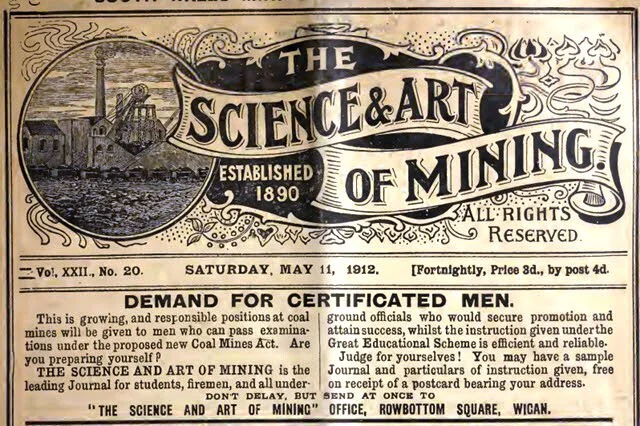
For much of the nineteenth and twentieth centuries, Wigan stood at the centre of one of Britain’s most important coalfields. The town’s mining heritage was expressed not only through its collieries, engineering works and technical schools, but also through a specialist journal which carried the name of Wigan throughout Britain’s mining districts.
The Science and Art of Mining was first published in Wigan in 1890 by Thomas Wall & Sons, the printing and publishing company associated with the Wigan Observer. Described as “an illustrated journal for mining and its kindred industries”, it became an important source of technical information, industry news and educational material for colliery officials, mining students and working miners.
Thomas Wall & Sons
Thomas Wall founded the Wigan Observer in 1853. From its printing works in Wallgate and Rowbottom Square, the business developed beyond newspaper production into general and specialist publishing.
The emergence of The Science and Art of Mining was a natural development for a Wigan-based printer. The surrounding district contained numerous collieries, ironworks and engineering firms, while the town already possessed a strong tradition of mining education through the Wigan Mining and Mechanical School, later the Wigan and District Mining and Technical College.
Thomas Wall & Sons therefore had access to both an industrial readership and a growing body of engineers, lecturers and mining specialists able to contribute technical material.
The first volumes
The first volume appeared in 1890 under the editorship of William Tate. Surviving volumes from the early 1890s show that the journal was already extensively illustrated, with technical drawings, diagrams, portraits and views connected with mining and engineering.
Its title reflected an important principle. Mining was increasingly governed by scientific knowledge, particularly in geology, ventilation, surveying, chemistry and mechanical engineering. At the same time, successful mining continued to depend upon practical experience—the “art” of applying that knowledge underground.
The journal attempted to bring these two traditions together.
It reported on subjects including:
- methods of working coal and other minerals;
- mine ventilation and the detection of firedamp;
- underground haulage and winding machinery;
- pumping and drainage;
- electricity in mines;
- mine surveying;
- explosives and shot-firing;
- colliery accidents and rescue work;
- new machinery and engineering developments;
- mining legislation and official regulations;
- technical examinations and professional qualifications.
Later editions also dealt with opencast mining, mechanised coal cutting, conveyors, locomotives, underground fires and the work of the National Coal Board.
Mining education and self-improvement
One of the journal’s most important purposes was educational. During the late nineteenth century, legislation placed increasing responsibilities upon colliery managers, under-managers, deputies, surveyors and other officials. Certificates of competency became essential for advancement within the industry.
Many ambitious miners studied in the evening after completing a full shift underground. Specialist publications allowed them to study mining practice, calculations, surveying, ventilation and legislation at home.
The Science and Art of Mining published examination questions, model or selected answers, technical problems and explanatory articles. It helped readers prepare for qualifications including colliery managers’ and under-managers’ certificates and, in later years, national and higher national certificates.
The periodical therefore formed part of a wider culture of working-class education and self-improvement. It offered a route by which a practical miner might acquire formal knowledge and progress into management, surveying, engineering or teaching.
Its connection with Wigan was particularly appropriate. The town had offered organised mining instruction from 1858, decades before technical education became widely available elsewhere. In 1909, C. M. Percy’s History of the Mining and Technical School, Wigan was itself published at the office of The Science and Art of Mining.
A wider publishing business
The success of the journal enabled Thomas Wall & Sons to develop a substantial range of mining books, manuals and instructional pamphlets. These were often advertised or issued through the Science and Art of Mining office in Wigan.
Among the titles associated with the firm were manuals on ventilation, coal working, mine gases, gas testing and preparation for professional examinations. Henry Davies’s How to Become a Colliery Manager, published by Thomas Wall & Sons in 1906, contained an appendix of examination questions extending over twenty years.
Other specialist works included Mine Gases and Gas Testing, published in 1913, which discussed firedamp, coal dust, colliery explosions and breathing apparatus. Such publications addressed matters upon which miners’ lives depended and demonstrate that the firm’s output extended well beyond ordinary commercial printing.
The company’s books circulated far outside Lancashire. Copies survive in university, museum and mining-history collections in Britain and overseas, showing the reach achieved by a specialist publication produced in Wigan.
Recording the people of the coalfield
Although primarily technical, The Science and Art of Mining also recorded the human and social history of the industry. Its pages contained portraits and biographies of mining engineers, trade-union representatives, colliery managers, inspectors, lecturers and public figures connected with coal mining.
An 1898 issue, for example, included a portrait of Benjamin Pickard, president of the Miners’ Federation of Great Britain and one of the leading figures in the organised miners’ movement.
The journal reported appointments, retirements and deaths, as well as meetings of professional institutions, mining competitions, educational achievements and developments in miners’ welfare. Reports of accidents and disasters provided contemporary accounts of events which are now important sources for historians.
It was not simply a record of machinery and production. Taken as a whole, its pages preserve the working culture of the British coalfield.
Robert Hedley Coulson
One of the journal’s longest-serving editors was Robert Hedley Coulson. At the time of his death in 1943, he was reported to have edited The Science and Art of Mining for approximately forty years.
Coulson guided the publication through a period of enormous change. During his editorship, mines increasingly adopted electricity, mechanical coal cutters, improved haulage systems and more sophisticated methods of ventilation and rescue. The industry also experienced major disputes, economic depression, two world wars and growing government intervention.
His long association with both the journal and Thomas Wall & Sons helped provide continuity while the mining industry around it was being transformed.
A changing industry
The journal continued into the period following the nationalisation of the coal industry in 1947. Volume LX, published in 1949, was followed by Volume LXI in 1950–51, Volume LXIV in 1953 and Volume LXVI in 1955.
By this time its contents included the work of the National Coal Board, mechanisation, electrical equipment, opencast operations and revised systems of technical education. Its ability to survive from the age of privately owned Victorian collieries into the era of nationalised coal demonstrates its usefulness to generations of mining professionals and students.
The precise date of its final issue requires further confirmation, but the publication continued for well over sixty years. It was a remarkable achievement for a specialist technical journal produced by a provincial printing company.
An important part of Wigan’s industrial heritage
The Science and Art of Mining deserves recognition as one of the most significant publications produced in Wigan.
It connected the town with mining communities across Britain and beyond. It helped students prepare for professional examinations, allowed engineers and managers to share new ideas, publicised improvements in machinery and working methods, and preserved accounts of the people and events that shaped the coal industry.
The journal also demonstrates that Wigan’s contribution to mining history was intellectual and educational as well as industrial. Coal was extracted from the district’s pits, but knowledge about how mines should be worked, managed and made safer was also printed and distributed from the town.
Through The Science and Art of Mining, the name of Thomas Wall & Sons—and the name of Wigan—became familiar wherever mining engineering was studied and practised.
Michael Nelson 2026
Sources
The Science and Art of Mining, surviving volumes and issue indexes, 1890 onwards.
Thomas Wall & Sons – Publication,
Durham Mining Museum, The Science and Art of Mining indexes.
Google Books Catalogue.
Census