The Legacy of Farmer Baker
Background
William Baker was born on the 10th September 1801 at Castle Farm, Winstanley, to parents Henry and Betty Baker (nee Rothwell).
It was his father’s business acumen that made them a fairly wealthy farming family after he bought corn cheaper than the going rate from other farmers whose markets were not open to others.
Due to the high price of flour, he was supplying the poor of the neighbourhood with a batch for baking at the same rate as he supplied it in sacks, which meant his business was greatly increased.
In 1817, Henry purchased Tewitt House farm at Goose Green; however, a disagreement with a Mr Banks had the family removed a short time after.
A couple of years later, he became the owner of another farming estate at Goose Green (Ashton Road), making a total of 44 statute acres between the two properties.
As a boy, William was never put to any great work and attended school in Billinge, achieving a fair education. His father died in 1841, meaning that William was 40 years of age and unmarried and only five years later he became enamoured with a lady of the same age, which had been broken off after a couple of years.
William would continue his father’s farming enterprise focusing upon dairy production. In 1859, William would go and visit Brunel’s ‘Great Eastern’ ship at Holyhead, which became the home port for voyages to America.
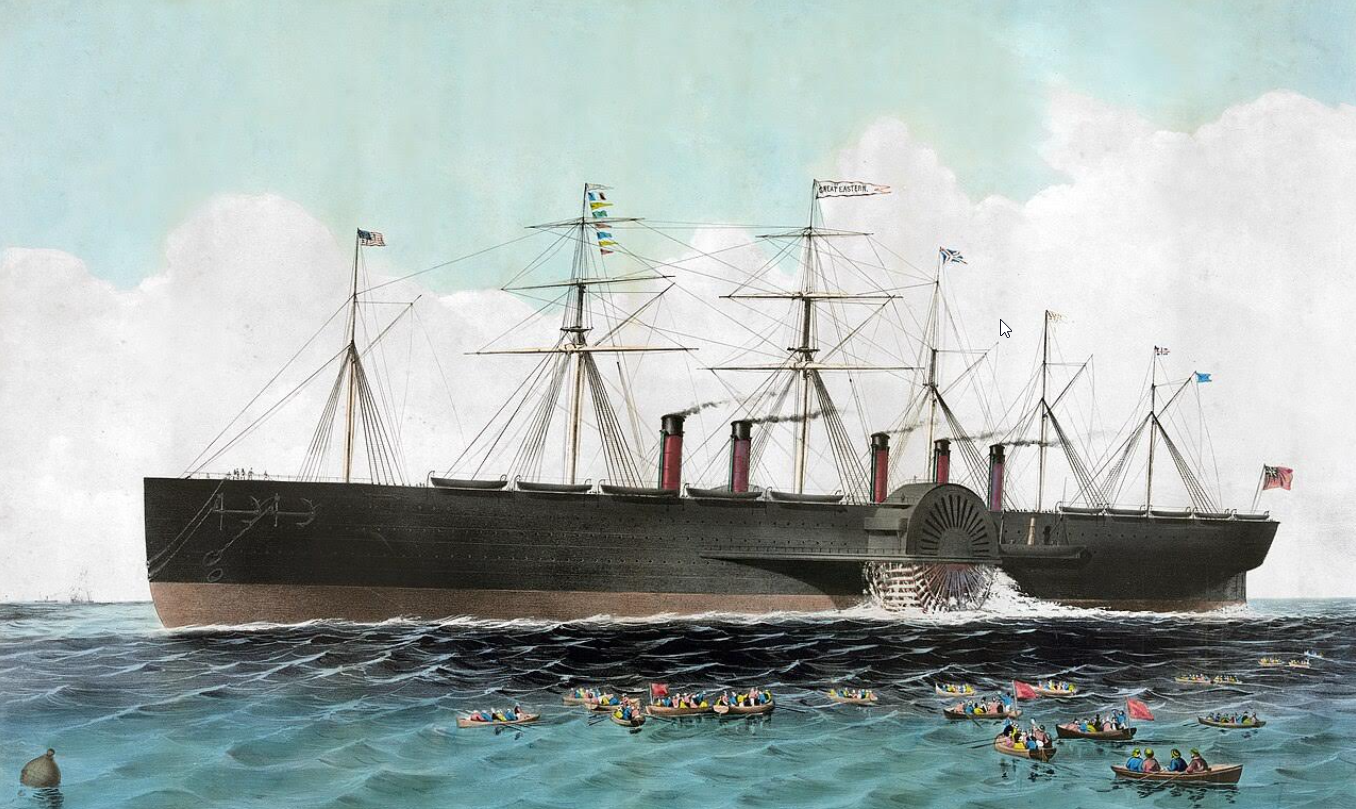
Image of Brunel's Great Eastern Ship - Wikipedia
Further fortunes would come the way of farmer Baker when a neighbouring colliery proprietor, Mr Blundell, offered him a set price of £12,000 for the coal under his land at Goose Green. He refused the price and agreed upon £150 per cubic foot per acre for fifty years, which would prove a much better deal. On the 1851 census, he was farming 30 acres, employing two farm labourers and two personal servants in residence.
At the time of his death in 1879, he was a member of the Pemberton Local Board, and for many years he was one of the honorary overseers of Pemberton alongside being a prominent member of the Highway Board and a member of the Wigan Board of Guardians for 33 years.
Farmer Baker was known to be very charitable by giving money towards churches, chapels and schools, including regular donations to a family descendant of the same name who was superintendent at the boys’ school at Park Lane Chapel.
This descendant, another William, would go on to serve the school for many years and on his return from Park Lane he would speak at the front gate of farmer Baker at Goose Green, who from time to time gave him a 5-pound note towards the running of the school. “I suppose you may need money sometimes at the school”, said farmer Baker.
However, trouble would arise after his death regarding the entitlement to his estate.
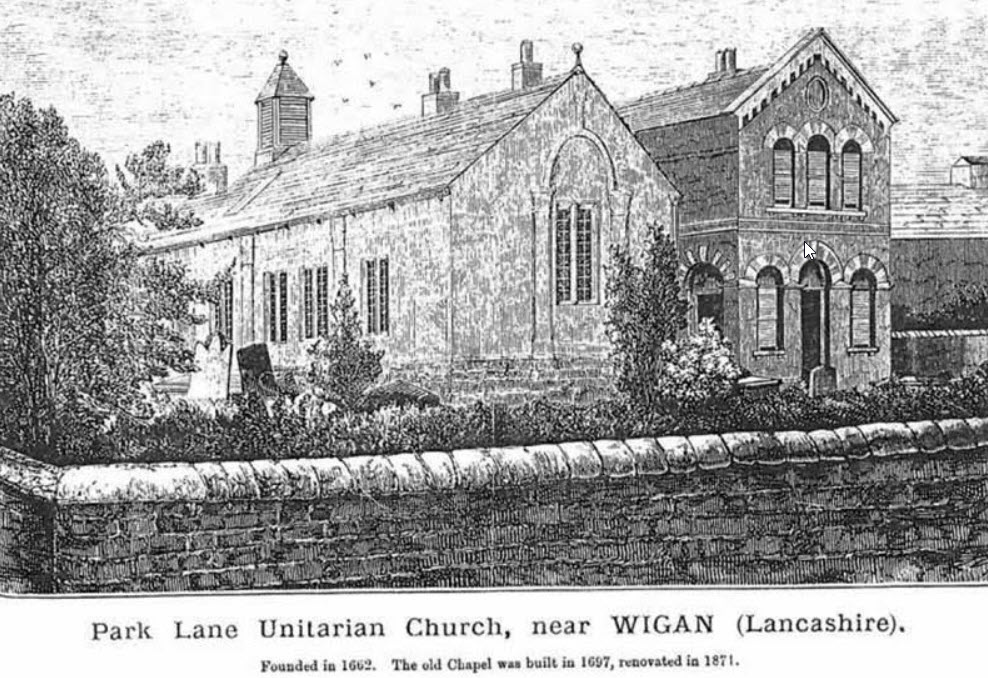 Park Lane Chapel - Genuki.org.uk
The Will
Having found no Will, William Baker of Hatton House Farm and John Jackson made the necessary arrangements for the deceased after being sent for by the housekeeper, Ann Baxter.
The assumed heir was a Mr Abraham Rothwell of Ellersley (from his mother’s side) who was the son of John and Mary Rothwell and claimed that his grandfather was the same grandfather of the deceased.
He was the nephew of farmer Baker’s mother Betsy Rothwell, and in turn first cousin of farmer Baker. During a high court hearing at Westminster presided by Sir James Hannen, he fought a Mrs Isherwood (first cousin once removed of farmer Baker) to the right of heir/next of kin.
Abraham was found to be entitled to the real estate before a Will was found at the home of farmer Baker, which created a whole load of problems for Abraham’s claim.
The Will was found within a book (‘Handy Book on Wills’ by Lord St Leonard’s) by the housekeeper of farmer Baker, Ann Baxter, from a hole in the ceiling where the steam churn was located. Witnesses to the signing of the Will were Michael Jackson (farmer at Goose Green) and Mr Henry Dawber, bailiff to Mr Walmesley at Westwood Hall however, both of these gentlemen were deceased.
According to the Will, Mrs Isherwood was entitled to £1000, one fifth to John Jackson, three fifths to his next of kin, one fifth and the whole of the realty to William Baker and £50 to his housekeeper Mrs Ann Baxter.
In the meantime, a box chair in Mr Baker’s bedroom was unlocked and proved between £30,000 and £40,000 in property, and his bank book showed £11,000.
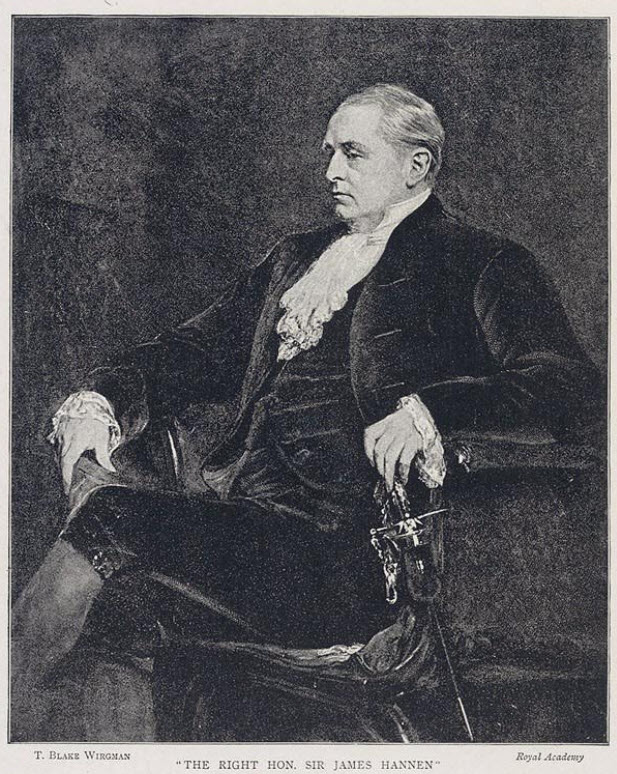 Sir James Hannen - Wikipedia
The Will was executed on the 24th October 1880 by William Baker before it was contested in 1881 by Abraham Rothwell, who stated that William Baker had forged the Will for his own means.
The case was again presided by Sir James Hannen, where banker Mr Woodcock was entirely convinced that the Will was in farmer Baker’s handwriting.
William Baker was already a reputable businessman at Baker & Valiant ironfounders of Hope Foundry on Clayton Street, Wigan, and, of course a strong member of the congregation at Park Lane Chapel and choirmaster, where his other duties lay with the boys’ school.
Nathaniel Eckersley (as banker) was also called to validate the signature of farmer Baker, in which he confirmed this was the correct signature from his visits to the bank. Eckersley said, “he would have passed any cheque of the testator with the signature as in the Will”.
Coincidentally, Eckersley had been a close friend to the defendant William Baker’s father, Thomas, who was an employee for Eckersley as a joiner at one of his industries. Upon Thomas's death, Eckersley led the funeral cortege to Park Lane Chapel.
The Times newspaper wrote, “it is clear that if the Will was forged, it was the work of one who was a master of the art, and who with historical knowledge equal to his skill in penmanship, might defy detection”.
The Jury came to no verdict after 3 hours in recess, where William Baker had “staked everything”; however, the evidence did at least relieve him of any forgery or concealment of the Will, but this wasn’t enough to avoid further litigation. If he was to have rights to the Will he would need to go through the court process once again at financial risk.
He had no resources available for another struggle in court and had friends propose a meeting where it was suggested by Mr C. F. Clark that there should be a compromise and that Nathaniel Eckersley should be requested to undertake the necessary negotiations.
Eckersley consented to mediate and the opposing parties gave their consent however, the outcome is unknown.
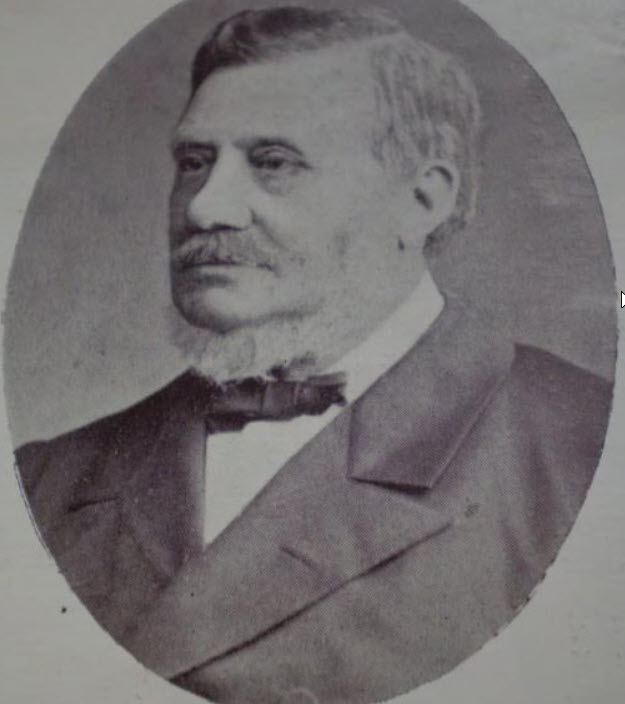
Nathaniel Eckersley - Wigan Local Studies
The expenses of the litigation amounted to £13,000 (1.4 million in 2026) and the claims to be met were so large that there was nothing left for William Baker who was left “broken in health and bankrupt in fortune”.
Another contest would come from a John Lawrence Turner who, like Mr Rothwell and Mrs Isherwood, thought that he was a next of kin to farmer Baker and so once again William Baker would be in court before Sir James Hannen in defence and represented by solicitors from Wigan, Peace, Ackerley & Co.
This time, however, William Baker was favoured, with Hannen stating that “the litigation had been instituted on the most shadowy ground”. Turner would have to foot the costs.
After all of these legal wranglings and an outcome that did not favour Mr Baker, he continued his role as superintendent at the boys’ school.
In 1885, Baker put up for auction nine lots of farms, building land and houses, including Hatton House Farm (21 acres) and, interestingly Tewitt House Farm (12 acres), which once belonged to farmer Baker courtesy of his father Henry. This leads me to believe that William Baker ended up with the realty of farmer Baker as declared in the Will although I can find no evidence within the press cuttings.
On the 1891 census, the first daughter of William Baker, Martha Alice, was living at Hatton House farm with her husband William Henry Baker (of WH Baker brassfounders) and their two daughters and one son. Martha’s brother William Thomas and sister Annette Margaret also in residence.
On the 1901 census, they are living at 366 Ormskirk Road after Hatton House Farm was purchased by a Mr Phythian.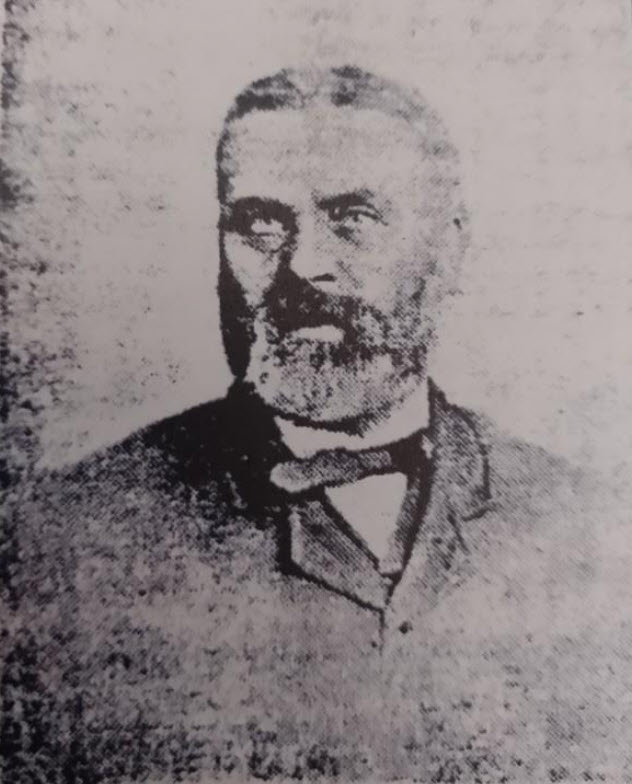
William Baker (1833-1892)
Margaret Baker died in 1885 before William remarried to Jane Parr at Farnworth in 1888, where they moved to a modest property at 323 Blackburn Road, Bolton.
William Baker died on March 28th 1892 at the age of 58. “Thy will be done” was William’s favourite hymn and found upon his memorial inscription at Park Lane Chapel.
I suspect Abraham Rothwell got his 3/5th of the estate as next of kin, and Mrs Isherwood her £1000. Proving it has been a difficult and ongoing task.
Andy Lomax.
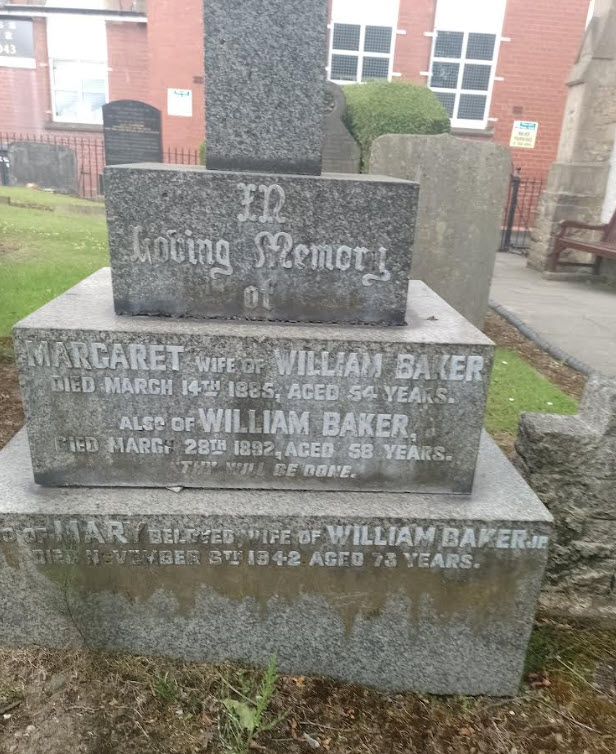 Barker Headstone at Park Lane Chapel