The Bradshaigh Nuns
In the early 1600s there were severe restrictions on Catholicism in England. The Gunpowder plot of 1605 had heightened anti Catholic feeling. However, many prominent Lancashire families continued to discretely practice their religion at risk of punishment. Rodger Bradshaigh (1577 to 1641) married Anne Anderton from a family of devout Catholics who risked their lives to produce pro-catholic books at a secret press in Birchley Hall, Billinge.
Rodger and Anne had 15 children who they raised as Catholics. Five sons and three daughters joined religious orders. For women wanting to devote their lives to their religion the only avenue was to join an English Convent in Exile. These were convents set up from 1598 in sympathetic countries such as modern-day France and Belgium.
Three Bradshaigh sisters, Elizabeth, Ann and Ellen became nuns at the Nazareth Convent in Gravelines, Northeast France, which at that time was part of the Spanish Netherlands. It had been set up in 1609 by the Order of St Clare known as the Poor Clares due to their austere lifestyle.
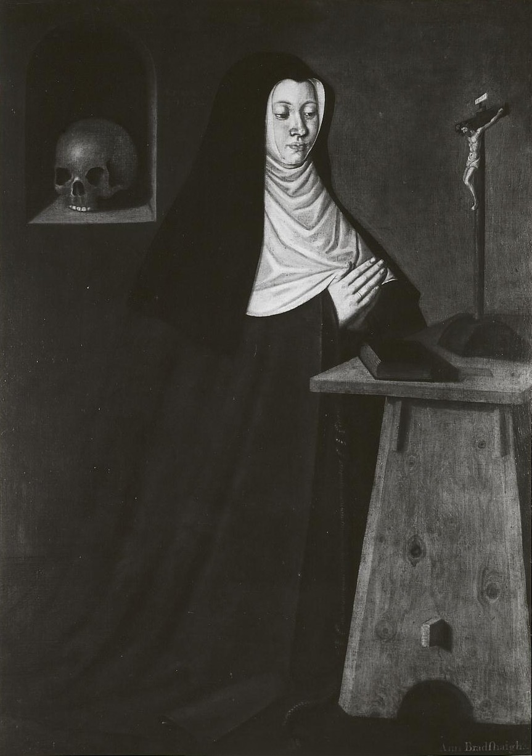
Elizabeth Bradshaigh 1611 to 1639
The convent records reveal Elizabeth and Ann taking their religious vows within 10 days of each other in August 1630. Elizabeth was 19 years old, Ann was 18. Ellen was nine years younger than Ann and took her vows in 1640 aged 21. The first vows were normally taken about a year after joining the convent.
The way of life of the Poor Clares was austere. It was a closed order. The nuns slept on straw sacks, ate meat only at Christmas and spent much of their day in silent prayer or contemplation, speaking only when necessary and with permission. A grill was erected between the cloister and the parlour through which they could communicate with the outside world.
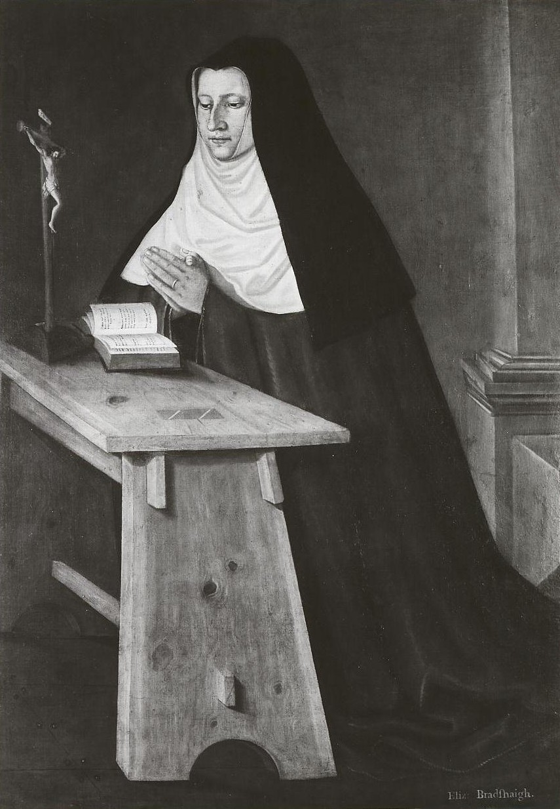
Ann Bradshaigh c1612 to 1666
Elizabeth’s name in the order was Elizabeth Clare, and she was a choir nun at Gravelines until she died there in 1639 at the age of 27. Ann’s name was Mary Ann Colette, and she remained a choir nun until her death in 1666 aged 54. Ellen was Mary Ignatia. She was a choir nun at Gravelines until 1644 when she moved to Rouen to help establish a new convent which was needed due to overcrowding at Gravelines. The convent records show her as Apothecary in 1644, Novice Mistress in 1656 and Vicaress in 1670. She died at Rouen in 1673 aged 54. Many of the nuns in exile had short lives. Although Ann lived for 54 years her obituary reveals that she had “20 years most painfull Infirmaties”.
Families who sent their daughters to the English Convents in Exile were expected to pay a dowry to support the costs of running the convent. There are no detailed records of the dowries paid, but wealthy families paid a significant amount.
Although the sisters were adopting a somewhat solitary lifestyle of religious worship and reflection, they were part of a large community of women from Lancashire families. Their cousin, Elizabeth Tyldesley, was the Abbess at Gravelines from 1615 to 1654 and will have welcomed their arrival. She was described as “the mother of many young women”. Several other relatives of the sisters attended the convents, including three cousins, four nieces, and seven great-nieces.
The convents existed until the French Revolution in the 1790s which promoted secularism. Most of the convents migrated to England where attitudes towards Catholicism were becoming less hostile.
The English Convents in Exile were at the forefront of providing education for young women and girls. Despite the practice being banned by Elizabeth I and subsequent Parliaments, girls were sent to Gravelines and later Rouen to be educated from an early age. Some returned to England while others stayed to take up holy orders. Mary Ward, who founded the convent at Gravelines, went on to set up a number of girls schools in the area despite fierce opposition. Described as “The first siter of feminism”, she is quoted as saying "There is no such difference between men and women that women, may they not do great things? And I hope in God that it may be seen in time to come that women will do much”. Prophetic words in the 1600s, and at a time when universities were debating if women had souls.
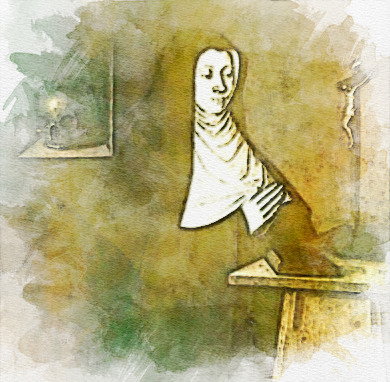
The portraits of Elizabeth and Ann depict them in habits, kneeling in prayer with a prayer book, and in front of a crucifix. The portrait of Elizabeth shows a skull in a recess behind her. This is probably a memento mori, a reminder that death approaches and the need to be spiritually prepared. Some sources suggest it is the skull of Elizabeth Tyldesley which was retained as a relic after her death. This cannot be the case as she died in 1654, and the portraits are believed to have been painted circa 1640. Some Poor Clare convents are known to have retained the remains of their dead, but there is no evidence that this was the practice at Gravelines. The skull may be the relic of a saint but there is no reference to it in the convent records.
Coincidentally the Tyldesleys are associated with the skull relic of a saint. Saint Ambrose Barlow was executed in 1641. He had been living at Morleys Hall with the Tyldesley family when he was arrested. The skull, believed to be his, is now kept at Wardley Hall, the official residence of the Catholic Bishop of Salford.
The Poor Clares had a tradition of recording the lives of their nuns. Records of their service were kept, and obituaries were written. These were read out annually on the anniversary of the nun’s passing. The obituaries for Elizabeth, Ann, and Ellen are reproduced below. They are translated using original spelling, punctuation and capitalisation as far as possible.
Elizabeth Bradshaigh
Anno Domini 1630 the 9th of August.
Made her holy Profession Sister Elizabeth Bradshagh, now Call’d Sister Elizabeth Clare the 19th year of her Age.
Anno Domini 1639 the 17th of February.
In our Convent of Nazareth of English Poor Clares in Graveline, is most happily departed this Life, strengthened with the Rights of our holy Mother the Church, our dear sister, Sister Elizabeth Clare Bradshagh, the 28th Year of her Age, & 10th since her entrance into holy Religion, wherein she served our Lord with Singular Innocency & purity of heart, Zeal, & fervour of Religious discipline. And her own advancement in all true Virtue, & in her last Sickness left us great examples of patience & Conformity to the Divine Will. For the happy rest of her Soul we most humbly crave the assistance of your Prayers & Suffrages of Charity. Requiescat in Pace.
Ann Bradshaigh
Anno Domini 1630 the 19th of August
Made her holy Profession Sister Ann Bradshagh, now Call’d Sister Mary Anna, being aged of 18 Years
Anno Domini 1666 the 8th of September
In our Convent of Nazareth of English Poor Clares in Graveline, is most happily departed this Life, furnish’d with all the Rights of our holy Mother the Church, our dear sister, Sister Collett, Mary Ann Bradshagh, the 55th Year of her Age, & 37 of her holy Profession, all which time she most laudably spent in the true and constant practice of those vertues most sutable to her holy Vocation, being most exact in holy Obedience & in all other Observances, even to the least Cerimony of our holy Religion, to which she hath ever been a most beneficial Member, by her great Zeal, prudence & Charity, a patron of patience by her humble Conformity to the divine Will, in Suporting above the space of 20 years most painfull Infirmaties. For the Speediest rest of whose Soul we humbly beg the assistance of your holy Prayers. Requiescat in Pace.
Ellen Bradshaigh
Anno Domini (1640) the 8th of September
Made her holy Profess: Sister Ellen Bradgshagh, now Call’d Sister Mary Ignatia, being Aged of 21 Years.
Anno Domini (1673) the 28th of December
In our Convent of Jesus, Mary, Joseph of English Poor Clares in Rouen is most happily departed this life strengthened with all the Rights of our holy Mother the Church, our most Reverend Moth: Vicaress, Sister Mary Ignatia Bradgshagh, the 55th Year of her Age, & 34th since her entrance into holy Religion whereof she spent 5 in our Convent at Graveline & both there, & here, hath left singular examples of piety, virtue, & Zeal of Religious observance to the last moment of her life, being most indefatigable in all that 4 was for the service of the Holy Religion, & for her own advancement, & others in perfection. She was sueet, & humble in Conversation, & most Charitable to all, but that which gave the greatest luster to her vertues, was her high esteem, & practise of holy Obedience, with a most singular conformity to the divine will which was remarkable in her last Sickness which was of 10 Months, which she bore with infinite patience. For whose speedy enjoyment of eternal bliss, your Prayers are most humbly craved. Requiescat in Pace.
Sources
Caroline Bowden, Collecting the Lives of Early Modern Women Religious: obituary writing and the development of collective memory and corporate identity, Women’s History Review, Vol. 19, No. 1, February 2010, pp. 7–20
Translation of Registers of the English Poor Clares at Gravelines, William Martin Hunnybun, annotated by Joseph Gillow, Catholic Record Society, Misc. IX, Vol. 14, 1914.
A New Pedigree of Bradshaigh of Haigh, Arthur J Hawkes, FSA, 1944
Who Were the Nuns website accessed 3 December 2025 https://wwtn.history.qmul.ac.uk/about/
Bert Rowest, “Scollers bredd Vp in the Monastery” Educating English Catholic Girls on the Continent, Radbound Repository, 2010
Jim Meehan 2026