Grass Among the Cobbles
An Old Concert Ticket Takes Me Back 68 Years!
Regular readers may remember me writing of my love for Scholes and its community. Recently, while taking a stroll around my old haunts, the memories came flooding back like a cascade and, suddenly, I was in the Scholes of old, with its many shops and public houses.
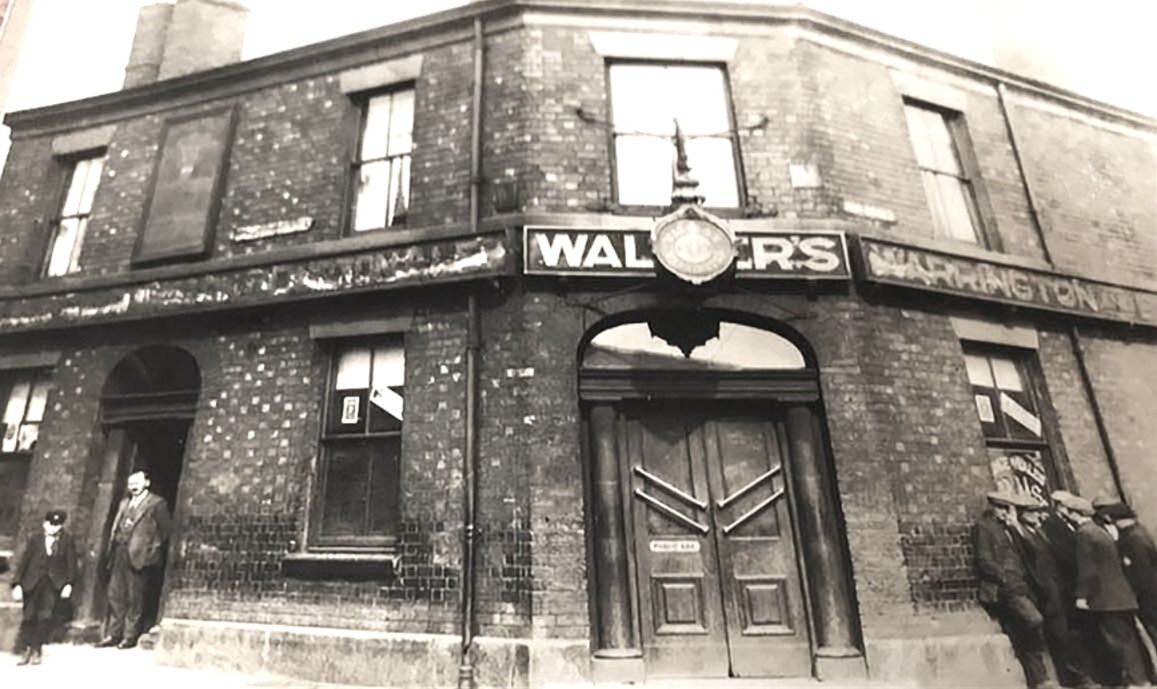 Prince of Wales
I’m sure younger people can’t possibly begin to understand what a vibrant community Scholes was, or the warmth and generosity of its inhabitants. As a child, I loved Scholes, and I still do. I wouldn’t have wanted to spend my childhood anywhere else in the world.
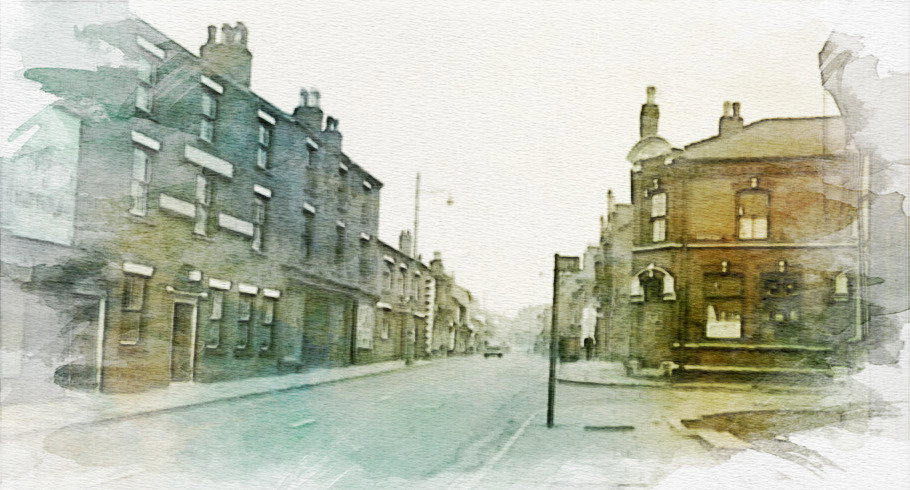
I look down Wellington Street with fond memories, a street no more than 150 yards long. In its past, it was home to six pubs: The Prince of Wales; The Wigan Arms, on its corner with Hardybutts; and, at the other end of the street, on its corner with Scholes itself, The Angel and The Shamrock. For good measure, there were two in the middle, The White Bear and The White Hart.
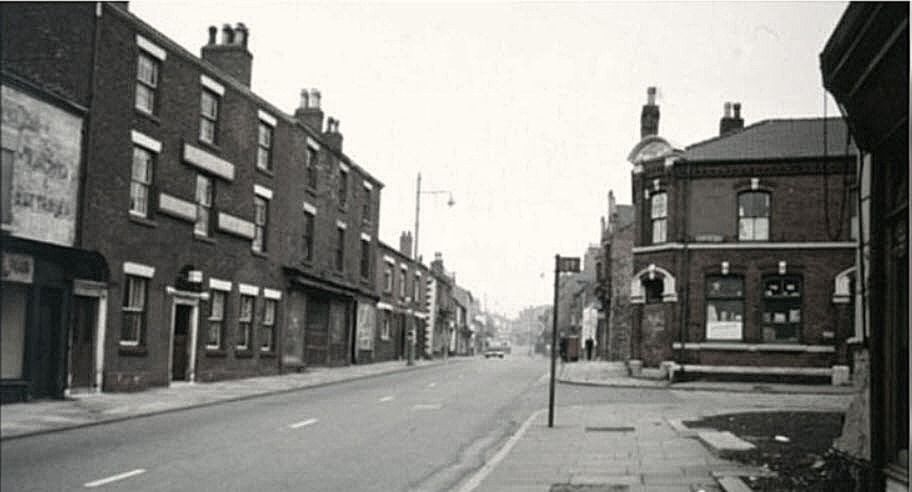 Wellington Street
I can clearly remember the ones on the corners, but in my youth The White Bear had been turned into two houses, and the site of The White Hart was vacant land.
As I gaze down the street, I think of the games we used to play: Skilly, Throw Out Can, Hide and Seek, etc.; the girls playing Hopscotch and Skipping Rope, doing handstands against a wall with their dresses tucked into their knickers.
One shop owner, with a less than pleasant disposition, would bawl sarcastically, “Go and play on the White Hart playing field!” It was full of old bricks and glass from the demolition.
Talking of shops, there were three grocers, a chip shop, a butcher’s, a toffee shop and a second-hand shop. The nearest thing we had to a delicatessen was Mrs Lynch’s Pie Shop, which also sold cooked meats and brawn (boiled pig’s head — yuck!), a particular favourite, no doubt because it was inexpensive at a time when every penny counted.
Plus, there were many houses. I can’t remember exactly how many, at least 16 and probably a few more, all in a street 150 yards long. Incredible that so much could be squeezed into such a short space.
Before I leave Wellington Street, I recall an incident in 1956. Some houses had been demolished, and new houses were under construction. A woman from the street died and, as was common in those days, her body was resting in the front room. In fact, there were no Chapels of Rest in those days.
I recollect old ladies remonstrating with builders, shouting, “A woman lies dead. Stop all the banging!” They wanted them to down tools until the funeral was over — probably five or six days!
There was a certain etiquette with death at that time. The house and all the neighbours would draw the curtains from the time of death until after the funeral. It would be considered almost sacrilege to have the television, or more likely the wireless, switched on in the house of the deceased. Family members would never think of going to The Pictures or, God forbid, dance halls or any places of entertainment.
On the evening before the funeral, The Rosary would be said. The family and friends would stay all night in the room where the open coffin was under the window, the face usually veiled, reminiscing about times gone by, joyous times and sad times.
A cup of tea, and maybe something stronger, would accompany the stories. Quite light-hearted conversation until the dawn broke and, as suddenly as a light being switched off, the atmosphere changed as the enormity and finality of the day ahead loomed.
From the corner of Wellington Street, I can see Saint Patrick’s Church, and more ghosts come rushing towards me: the old Boys’ School, now long gone; the Girls’ School likewise. The Girls’ School was far more modern, built in 1926. An unusual feature was that the senior girls’ playground was on the roof! The reason for this innovative design was the limited ground available.
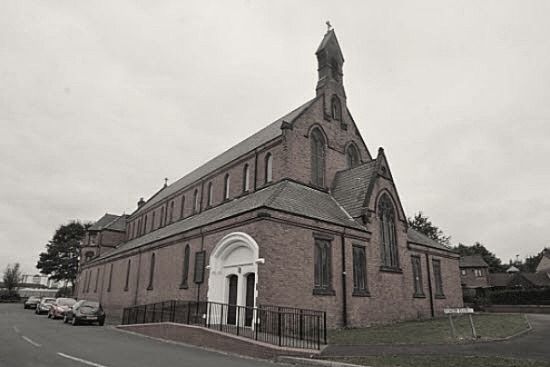 St. Patrick's Church
The Boys’ School was converted from the first church. An extension was added to the rear of the building to accommodate the growing demand.
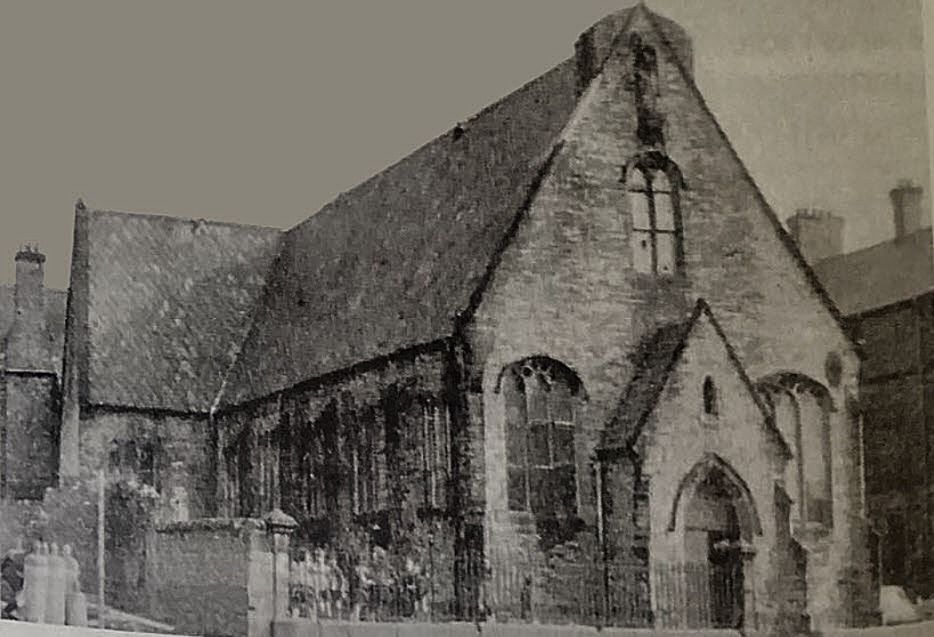 St. Patrick's School
I visualise the scenes on Whit Monday, when not only the parish but the whole of Wigan came to a standstill. I can hear the pipe bands tuning up. The sheer excitement was palpable. Again, people of a certain age will find it impossible to understand what a big day this was. Flags flying everywhere, chairs left out the night before all along the route.
I toy with the idea: if you could go back in time to your youth, which day would you choose — Whit Monday, Christmas Day, Blackpool Holidays, the ferry to New Brighton?
I content myself with the realisation it would never happen anyway — but if it did, Whit Monday would certainly be a contender.
Before I leave St Patrick’s, I must give mention to ‘The Bell’. In the 1950s, everything in the parish revolved around getting a new bell. Children collected milk bottle tops and silver paper. Older parishioners held jumble sales and concerts.
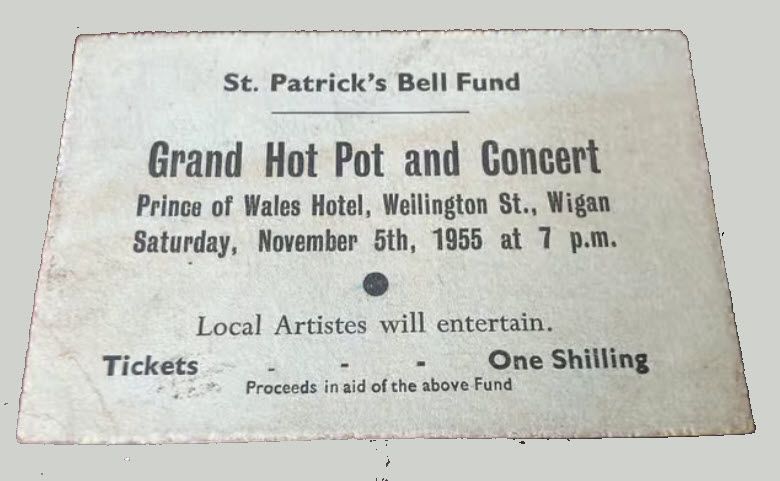 An older resident recently gave me an old ticket showing: ‘A GRAND CONCERT, TO BE HELD IN THE PRINCE OF WALES, in aid of The Bell.’
In fact, it was this ticket turning up that gave me the notion to walk around my old stomping ground. Driving around, we don’t have the impetus to think of times of yore.
Walking, by contrast, allows you time to think of the past — good times and times of trouble.
The parish finally got its bell after years of fundraising. It wasn’t a complete success, but that’s another story for another day.
Time to move on to Scholes itself. In my mind’s eye, I can see every shop, every pub, every business imaginable: Chinese Laundry, Chemist, Picture House, many, many grocers and butchers, Pie Joe’s, Motorbike Shop, McNulty’s Shoe Shop, Post Office.
People used to say if you could put a roof over Scholes in its heyday, we’d have the first Trafford Centre!
At one time, believe it or not, there were 62 pubs in Scholes and district. As in the first paragraph, I’ll name them from Scholes lights to Greenough Street lights. These were still open when I was young.
Starting from Scholes lights, left-hand side: Blue Bell, Kings Arms (my Dad was born in the establishment in 1912), Crown and Sceptre, Black Swan, White Swan and The Windmill.
On the right-hand side: The Fleece, The Angel, The Shamrock, The Conservative Club, The Harp and The Rose and Crown, known by one and all as The Dust Hole.
It’s said if you had a pint in every venue, you’d be legless before you got halfway!
The trees and gardens that now adorn Scholes, and the smart new houses, contrast with the old thoroughfare in times gone by. In those days, you’d be lucky to find a blade of grass between the cobbles.
Although we did have ‘Scholes Park’ on the lower part of Scholes, opposite another pub, The Shovel and Broom. I say park; it was really anything but.
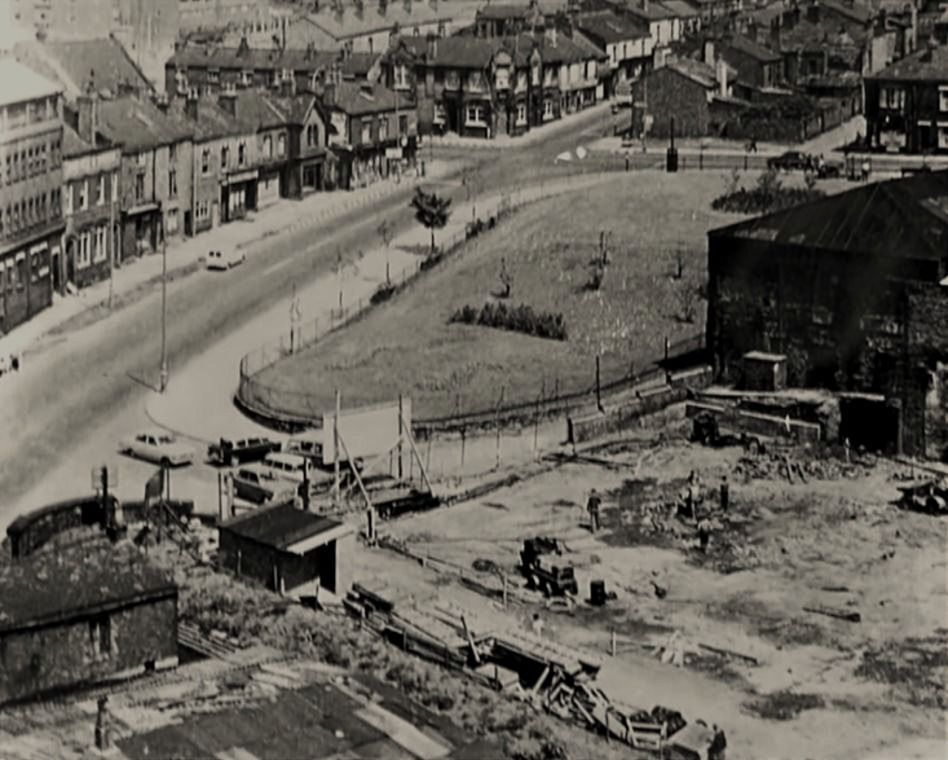
Scholes Park!
A park, you imagine, is something open to the public. Not so this park. It was completely surrounded by railings, only opened when the council came to cut the grass.
I take a seat in the ‘new’ park (new! It’s probably over 65 years since the railings came down and it was landscaped), with its benches and well-laid-out gardens. I ponder why this couldn’t have been done in the past.
I start to think of the harm George Orwell did to Wigan in general, and Scholes and Wallgate in particular, in his bigoted book The Road to Wigan Pier. My annoyance knows no bounds when I think of this book and how it maligned our town.
It purports to read like a report by a well-meaning outsider. An outsider he was; well-meaning he certainly wasn’t.
Anyone who didn’t know these areas, reading the book — people from faraway places and, indeed, people from better-off parts of our own town — would conclude that every house in Scholes and Wallgate was filthy.
It is true that many houses, probably the vast majority, were in need of repair and some demolition, the vast majority with outside toilets.
In 1936, when he visited our town, these areas would be lit mainly by gas. It’s also true that there was poverty in many households. This was not confined to certain parts of Wigan, far from it. The whole country, indeed the world, was in the middle of ‘The Great Depression’, which lasted a full decade, 1929–1939. America and Germany fared worse than most. The United Kingdom, by comparison, did significantly better than those nations.
What is not true is his description of the cleanliness of houses. People had pride in their homes and did their very best in difficult circumstances. Women would mop the step every single day, including an area of the pavement immediately outside the step, polish windowsills and sweep the pavement.
Every day it would be a different task: Monday, washing day; Tuesday, bedrooms; and so forth and so on. People used to say there was a rainbow over Scholes on Mondays, so many households doing their washing.
Of course, you could find houses that were filthy then, and indeed now. I contend that Orwell sought out these houses diligently to suit the book he was going to write. He had preconceived ideas about the North of England and working-class people.
He came with an agenda to reinforce his prejudices. This is so obvious by his choice of lodgings. Gerry Keenan, a trade unionist, had found him a perfectly nice place to stay. For whatever reason, he left after a few days. Then the search was on to find a place that would suit his desire to find accommodation as filthy as possible, for nothing more than shock value.
So much for honesty in reporting. Shock is a good tactic for selling books.
I must, however, however reluctantly, give credit to him for the part of the book that deals with the terrible conditions of miners.
I was fortunate to be asked by The Wigan Observer to comment on the book on the 75th anniversary of its publication. Mine was a very harsh critique. On the same page, a member of The Orwell Society, which of course gave a gushing review.
We were to meet a couple of weeks after the articles at an event held at The Museum of Wigan Life in connection with the anniversary. To say he was less than pleased to see me is an understatement. He made it very clear that he disagreed with my assessment, which is his right. I made it equally clear that I stood by every word I’d written. I wasn’t going to take lessons from someone with little or no knowledge of Wigan.
I wrote an article concerning the book. Anyone interested in reading it, simply type — A Book is Immortal, Tom Walsh. The article highlights more fully my objection to its content and to the unfairness of the book to Wigan and its people, Scholes and Wallgate taking the brunt of his spiteful pen.
I’ll finish this article with an analogy I’ve used before when walking down Memory Lane. I think you need to be born to the sound of St Patrick’s, St Catherine’s or St Joseph’s bells to understand the sheer goodness of the people of this part of Wigan.
I’m also reminded of a song an old Irish lady used to sing, ‘The Old House’. After singing, she would always say in a lovely Irish lilt, “Sure it would make a stone cry.”
I must admit, when I hear it, it brings a tear to my eye. The words are really poignant and ring so true for me.
It can be heard on YouTube. Listen
Get your hankies ready!